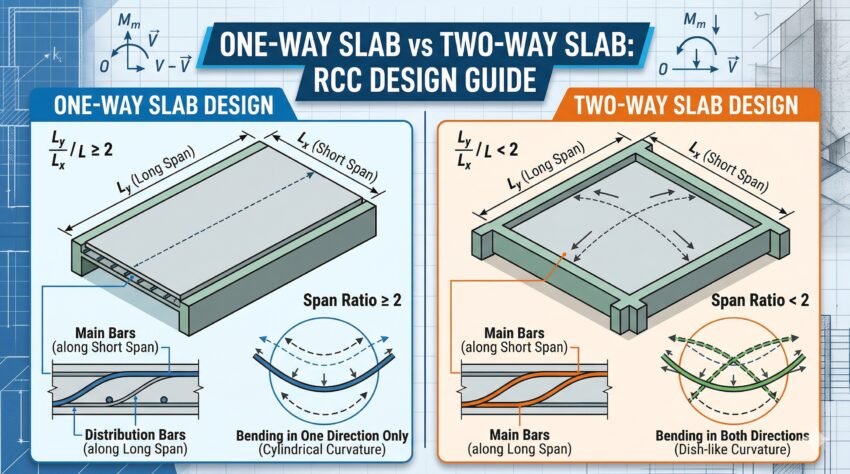
The comparison of the One Way Slab v/s Two Way Slab is based on the ratio of the longer span length to the shorter span length of the slab.
What is a One-Way Slab?
If the ratio of longer span to shorter span is more than two, say the slab resembles a rectangle, then it is called a One-Way Slab.
Properties of One-Way Slab
- We need to provide main steel along the shorter span and distribution steel along the longer span in the one-way slabs.
- The two longer opposite sides support most of the load of slab.
- The deflected shape of a one-way slab is cylindrical.
- The bending stress occurs in a one-way slab is only in the shorter span.
- In a one-way slab, calculations for the bending moment are similar to RCC beam design.
What is a Two-Way Slab?
If the ratio of the longer span of the slab to the shorter span is less than or equal to two, then it is called a Two-Way Slab.
Properties of Two-Way Slab
- This slab transfers its load to all four supporting beams.
- We need to provide the main reinforcement in both directions of the slab.
- The deflected shape of a two-way slab is like a saucer.
- The bending occurs in a two-way slab in both directions.
There are two types of Two-Way Slabs.
- Simply Supported Two-Way Slab – There is no restraint at corners for lifting up in this type of slab.
- Restrained Two-Way Slab – In this type of slab, corners are kept held down and thus torsion reinforcement is needed.
Read Also-
Download SP 34 : 1987 – Handbook of Concrete Reinforcement and Detailing
Prestressed Concrete and Its Advantages and Disadvantages