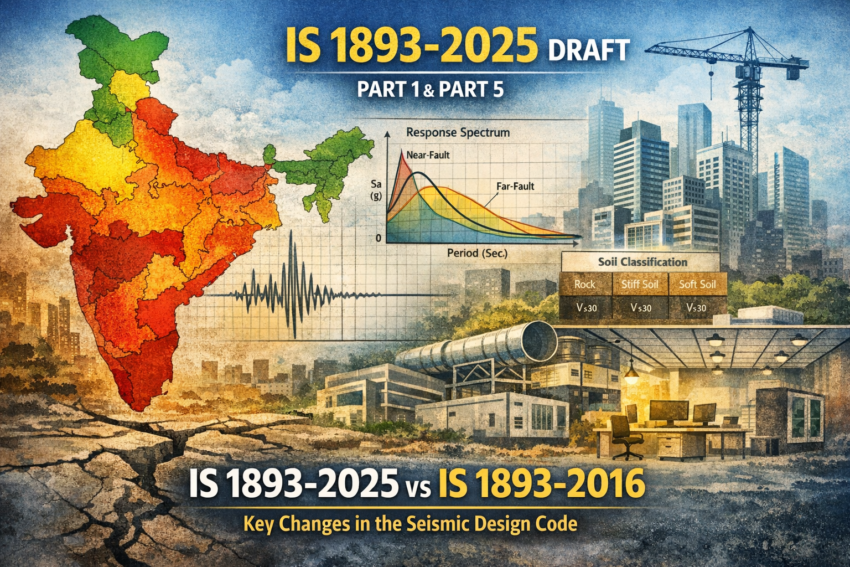
IS 1893 : 2025 is a major revision that separates general hazard provisions (Part 1) from building‑specific rules (Part 5) and modernizes seismic design by introducing probabilistic hazard inputs, expanded spectral definitions, and stronger geotechnical and nonstructural requirements.
Download IS 1893 : 2025 Part 1 with this link
Download IS 1893 : 2025 Part 5 with this link
| Topic | IS 1893‑2016 | IS 1893‑2025 Change | Immediate Design Impact |
|---|---|---|---|
| Hazard philosophy | Deterministic zonation and fixed zone coefficients. | Shift to probabilistic seismic hazard assessment (PEHA). | More site‑specific hazard inputs. |
| Seismic zoning | Four seismic zones (II–V). | Revised zonation with finer granularity. | Reclassification affects base shear. |
| Design spectra | Spectra up to ~6 s. | Extended spectra up to ~10 s; near‑fault & far‑fault motions. | Revised demands for tall buildings. |
| Design PGA & Z values | Fixed Z‑values per zone. | Recalibrated probabilistic PGA values. | Importance category affects design acceleration. |
| Soil, SSI & liquefaction | Basic site classification. | VS30, detailed SSI, updated liquefaction checks. | Greater geotechnical involvement. |
| Nonstructural elements | Limited guidance. | Explicit AEU design with floor spectra. | Mandatory coordination with MEP & façade teams. |
| Structural systems & R | 2016 R‑values. | Recalibrated R‑values; clearer admissibility. | Changes in detailing & ductility expectations. |
| Analysis requirements | Static/dynamic; optional time‑history. | Stricter time‑history with prescribed suites. | More projects require dynamic verification. |
Expanded salient points of IS 1893 : 2025
- Probabilistic hazard mapping and return‑period spectra. The code now uses PEHA to derive zone values and design accelerations, so design inputs are tied to specified return periods rather than a single deterministic coefficient.
- Long‑period and near‑fault treatment. Spectra are extended to cover longer periods relevant to tall and flexible structures, and the draft prescribes suites of near‑fault and far‑fault ground motions for response‑history analyses.
- Stronger geotechnical integration. VS30‑based site classification, formal soil‑structure interaction procedures, and revised liquefaction assessment methods require deeper geotechnical input into structural design.
- Nonstructural design elevated to code requirement. AEUs (façades, ceilings, MEP equipment, utilities) have explicit design spectra and displacement/acceleration limits, making coordination between structural, architectural, and services teams mandatory.
- System‑based rules and recalibrated R values. The draft clarifies admissible structural systems for buildings and recalibrates elastic force‑reduction factors to reflect updated ductility and performance expectations.
- Reorganization for clarity. Splitting general provisions (Part 1) from buildings (Part 5) improves usability and allows future parts to address other structure types (bridges, tanks, base‑isolated buildings) separately.
Rollback of IS 1893 : 2025 by BIS in March 2026
Multiple stakeholders raised concerns about changes in the code. Some of the stake holders are including:
- State governments Many cities were moved into higher seismic zones, which implied higher construction costs and stricter design requirements.
- Infrastructure agencies & developers The new provisions increased structural demands, affecting budgets for housing, public buildings, and infrastructure projects.
- Industry bodies They argued that the shift to probabilistic hazard assessment (PEHA) required more data, expertise, and time before nationwide adoption.
- Seismology & engineering experts Some experts felt the zonation changes needed further calibration and peer review.
Because of this widespread feedback, the government asked BIS to pause implementation and re‑examine the draft.
Read Also-
International Building Code 2018 Version
International Building Code 2021 Version
Download NBC 2016 – Volume 1 & Volume 2 (National Building Code of India)
IS 800 – 2025 Draft Version (General Construction in Steel)
IS 1893 part 1 2016 Criteria for Earthquake Resistant Design of Structures