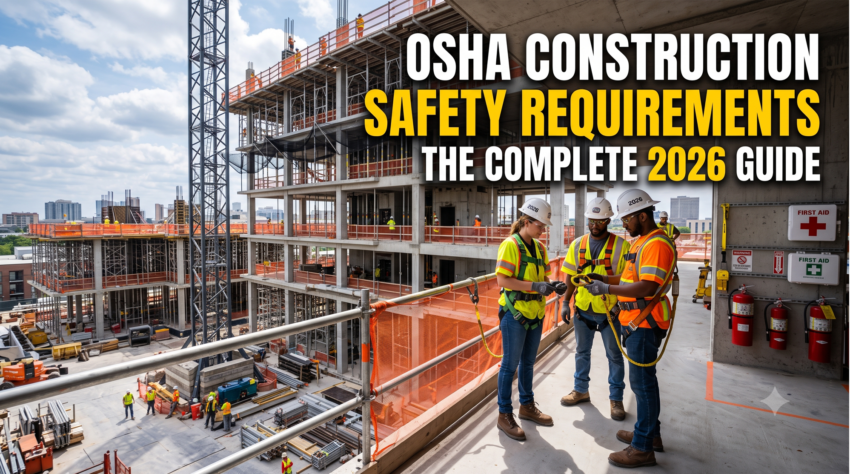
Construction workers face the most casualties in their field in US. Roughly one in five workplace fatalities in the private sector happens on a construction site, and the same hazards show up year after year: “falls, struck-by incidents, electrocutions, and caught-in/between accidents — what OSHA calls the “Focus Four”.
That’s why the Occupational Safety and Health Administration (OSHA) enforces a dedicated set of construction safety standards. If you’re a contractor, site supervisor, safety manager, or even a self-employed tradesperson working on US job sites, understanding these requirements isn’t optional. Violations can cost up to $16,550 each — and up to $165,514 for willful or repeat violations.
This guide breaks down the core OSHA construction safety requirements, the most-cited violations, mandatory training, and practical steps to keep your job site compliant in 2026.
What Is OSHA and Who Must Comply?
OSHA is the federal agency under the US Department of Labor responsible for ensuring safe and healthful working conditions. It was created by the Occupational Safety and Health Act of 1970, which also established the General Duty Clause — the requirement that every employer provide a workplace “free from recognized hazards” likely to cause death or serious physical harm.
Who must comply to OSHA Construction Safety Requirements?
– Virtually all private-sector construction employers in the US, regardless of size
– General contractors and subcontractors (both can be cited on multi-employer worksites)
– Employers in the 22 states and territories with OSHA-approved State Plans (like Cal/OSHA in California), which must be *at least* as strict as federal OSHA
Who are exempted?
genuinely self-employed individuals with no employees, and immediate family members of farm employers. But be careful — misclassifying workers as independent contractors does not shield you from OSHA liability.
The Core Standard: 29 CFR Part 1926
Construction safety requirements live in Title 29 of the Code of Federal Regulations, Part 1926 (general industry rules are in Part 1910). Part 1926 is organized into subparts, each covering a hazard category. The most important ones for day-to-day compliance:
| Subpart | Covers | Key Standards |
|---|---|---|
| Subpart C | General safety & health provisions | 1926.20–.35 |
| Subpart E | Personal protective equipment (PPE) | 1926.95–.106 |
| Subpart K | Electrical | 1926.400–.449 |
| Subpart L | Scaffolds | 1926.450–.454 |
| Subpart M | Fall protection | 1926.500–.503 |
| Subpart P | Excavations & trenching | 1926.650–.652 |
| Subpart X | Stairways and ladders | 1926.1050–.1060 |
| Subpart CC | Cranes & derricks | 1926.1400+ |
Let’s walk through the requirements that generate the most citations — and the most injuries.
Common Requirements for Different Purposes
-
Fall Protection (1926.501) — OSHA’s #1 Cited Violation:
Fall protection has been OSHA’s most frequently cited standard for 15 consecutive years, with 5,914 violations in fiscal year 2025 alone. Falls are also the leading cause of death in construction.
The core rule: Workers exposed to falls of 6 feet or more above a lower level must be protected by one of three systems:
– Guardrail Systems — top rails at 42 inches (±3″), able to withstand 200 lbs of force.
– Safety net systems — installed as close as practicable below the work surface, never more than 30 feet below.
– Personal fall arrest systems (PFAS) — full-body harness, lanyard, and anchor point rated for 5,000 lbs per worker.
Specific triggers include unprotected sides and edges, leading edges, holes and skylights, roofing work, and wall openings. Fall protection **training** is a separate requirement under 1926.503 — workers must be trained by a competent person to recognize fall hazards and use protection systems correctly, and the training must be documented in writing.
-
Scaffolding (1926.451):
Scaffold violations climbed in FY 2025 even as most other categories declined. Key requirements:
Scaffolds must support their own weight plus **4 times the maximum intended load**
Platforms must be fully planked, at least 18 inches wide
Guardrails or PFAS required at 10 feet or more above a lower level
– A **competent person** must inspect scaffolds before each work shift and after any event that could affect structural integrity
-
Ladders and Stairways (1926.1053):
Ladder violations ranked third on OSHA’s list with 2,405 citations in FY 2025. The basics:
– Extension ladders must extend **at least 3 feet above** the landing surface
– Maintain the **4-to-1 rule**: one foot out from the wall for every four feet of height
– Never load a ladder beyond its rated capacity, and never use the top step
– Inspect ladders for defects before use; tag and remove damaged ladders immediately
– Maintain three points of contact when climbing
-
Excavation and Trenching (1926.651–.652):
Trench collapses kill quickly — a cubic yard of soil can weigh as much as a car.
OSHA requires:
– Protective systems (sloping, benching, shoring, or trench shields) for any excavation
5 feet or deeper- A competent person must inspect trenches daily and after rainstorms
– Ladders, ramps, or other safe egress within 25 feet of workers in trenches 4 feet or deeper
– Spoil piles and equipment kept at least 2 feet from trench edges
– Atmospheric testing where oxygen deficiency or toxic gases are possible
-
Personal Protective Equipment (Subpart E)
Employers must assess job site hazards, provide appropriate PPE **at no cost to workers** (with limited exceptions), and train workers on its use.
Common requirements:
– Hard hats where there’s risk of falling objects or head contact with electrical hazards
– Eye and face protection (1926.102 — a top-10 violation with 1,665 citations in FY 2025) for cutting, grinding, welding, and chemical exposure
– High-visibility clothing for workers exposed to vehicle traffic
– Hearing protection when noise exposure exceeds permissible limits
– Respiratory protection (with medical evaluation and fit testing) for silica dust, asbestos, and other airborne hazards
-
Hazard Communication (1910.1200)
Even though HazCom is a general industry standard, it fully applies to construction and was the second most-cited violation in FY 2025 (2,546 citations). Requirements include a written HazCom program, GHS-compliant labels on all chemical containers, accessible Safety Data Sheets (SDS), and employee training on chemical hazards — from concrete admixtures to solvents and adhesives.
-
Electrical Safety (Subpart K)
Electrocution is one of construction’s Focus Four killers. Core requirements:
What are OSHA Training Requirements?: OSHA 10 and OSHA 30
The OSHA requires training for specific hazards (fall protection, scaffolds, excavation, etc.), and the OSHA Outreach Training Program is the industry-standard way to deliver broad safety awareness:
– OSHA 10-Hour (Construction): entry-level workers. Covers the Focus Four, PPE, and worker rights.
– OSHA 30-Hour (Construction): supervisors, foremen, and safety personnel. Deeper coverage of hazard identification and management responsibilities.
Federal OSHA doesn’t mandate OSHA 10/30 cards nationwide, but **several states do** — including New York, Connecticut, Massachusetts, Missouri, Nevada, New Hampshire, Pennsylvania, and Rhode Island — for public works projects or all construction work. Many general contractors and project owners also require them contractually.
Recordkeeping and Reporting Requirements
OSHA 300 Log: employers with more than 10 employees must record work-related injuries and illnesses (Forms 300, 300A, and 301)
Form 300A posting: the annual summary must be posted at the workplace from February 1 to April 30 each year
Fatality reporting: Report any work-related fatality to OSHA within 8 hours
Serious injury reporting: Report any inpatient hospitalization within 24 hours
Electronic submission: establishments with 20+ employees in construction must submit Form 300A data electronically by March 2 annually
OSHA Penalties in 2026: What Violations Cost
For 2026, there was no inflation-based increase to OSHA civil penalties, so the 2025 penalty amounts remain in effect. Current maximum penalties:
| Violation Type | Maximum Penalty (2026) |
|---|---|
| Serious | $16,550 per violation |
| Other-than-serious | $16,550 per violation |
| Failure to abate | $16,550 per day beyond abatement date |
| Willful or repeat | $165,514 per violation |
How OSHA Inspections Work?
A typical inspection includes an opening conference, a walkaround (where the compliance officer can photograph hazards and interview workers privately), and a closing conference. Workers have a legal right to request an inspection and to speak with inspectors confidentially — retaliation against workers who raise safety concerns is illegal under Section 11(c) of the OSH Act.
Building a Compliance Program: Practical Checklist
1. Conduct a written hazard assessment for every job site before work begins
2. Designate competent persons for fall protection, scaffolds, and excavations
3. Train and document — OSHA 10/30 cards, toolbox talks, and standard-specific training with signed records
4. Inspect daily — scaffolds, trenches, ladders, PPE, and electrical cords
5. Maintain your OSHA 300 log and post Form 300A each February
6. Create a written safety program covering HazCom, PPE, emergency action, and fall protection plans
7. Audit subcontractors: — on multi-employer sites, controlling contractors can be cited for subs’ violations
8. Use free help: OSHA’s On-Site Consultation Program** provides no-cost, confidential compliance assistance to small businesses — with no citations or penalties resulting from the visit
The Bottom Line
OSHA construction safety requirements aren’t just regulatory boxes to check. A documented safety program, trained competent persons, and daily inspections do more than avoid $16,550 citations; they keep your crew alive and your projects on schedule.
Start with the Focus Four, fix your fall protection program first, and take advantage of OSHA’s free consultation services if you’re a small contractor. Compliance is far cheaper than a citation — and infinitely cheaper than a fatality.
Read Also-
How BIM Is Transforming the Future of Civil Engineering?
Top 5 Best Construction Scheduling Software
Flooring Installation in Buildings: A Complete Guide
Top 10 Building Materials Companies in the USA
FAQs
Up to $16,550 per serious violation and up to $165,514 per willful or repeat violation. Penalty levels did not increase for 2026.
Falls, struck-by objects, electrocutions, and caught-in/between hazards — together responsible for the majority of construction fatalities.
Six feet above a lower level under 29 CFR 1926.501. (General industry is 4 feet; scaffolds are 10 feet.)
Yes, in limited circumstances — when there’s a reasonable belief of imminent danger, the employer has been asked to fix it, and there’s no time for an OSHA inspection.