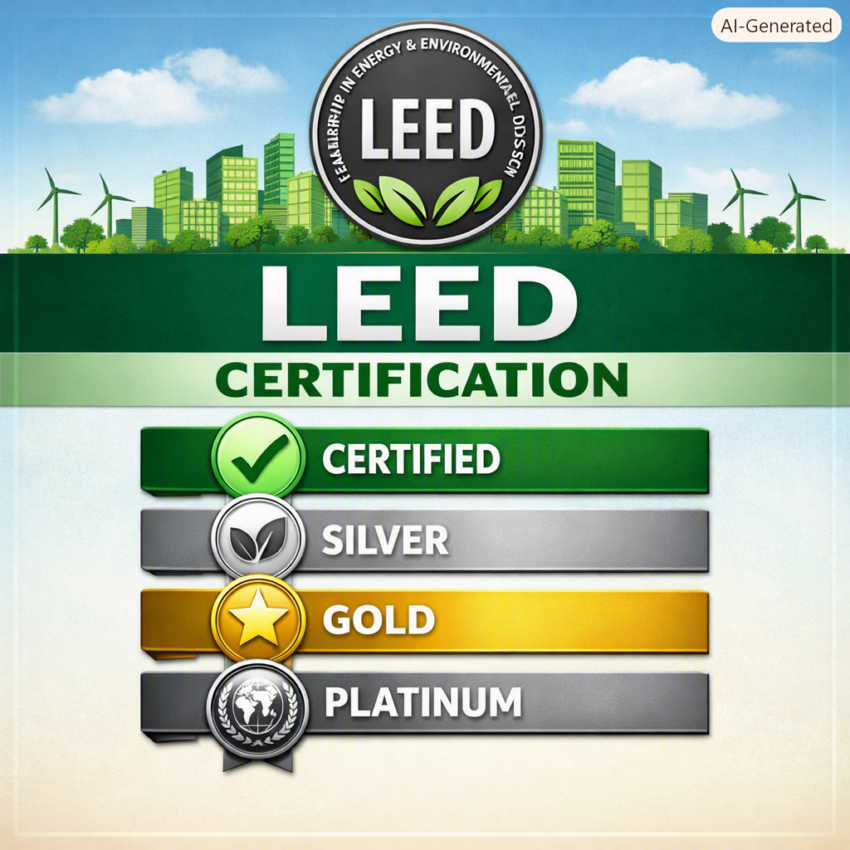
LEED certification in the USA is structured into four levels — Certified, Silver, Gold, and Platinum — based on points earned across sustainability categories. Platinum requires 80+ points plus new decarbonization credits under LEED v5, making it the most rigorous standard.
🌱 What is LEED?
- LEED (Leadership in Energy and Environmental Design) is the world’s most widely used green building rating system, developed by the U.S. Green Building Council (USGBC) and certified by Green Business Certification Inc. (GBCI).
- It provides a framework for healthy, efficient, and cost-effective buildings across all project types: new construction, interiors, operations, neighborhoods, and even cities.
LEED Certification Levels
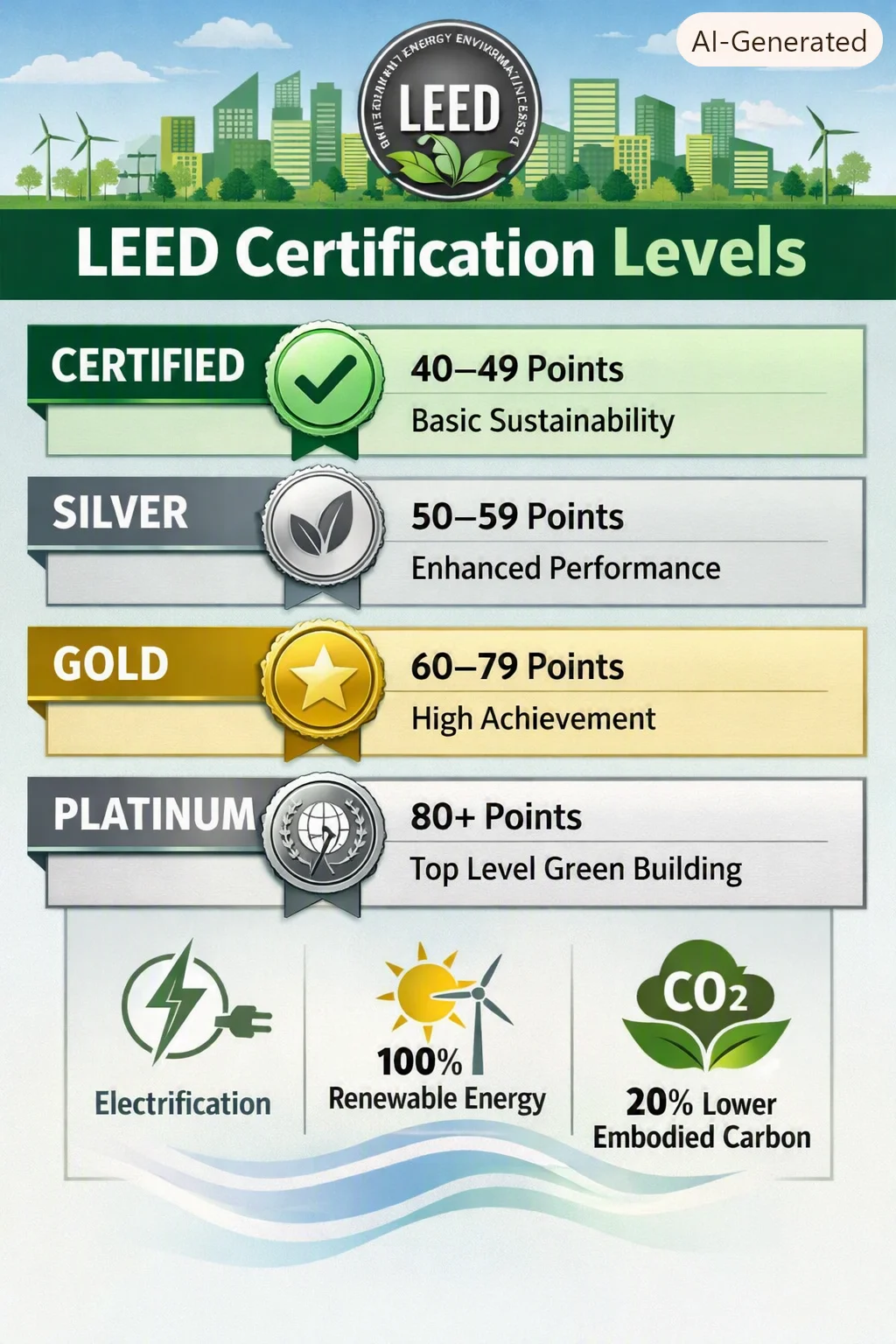
Projects earn points (out of 110 available) by meeting sustainability credits. The total determines the certification level:
| LEED Level | Points Required | Key Notes |
|---|---|---|
| Certified | 40–49 | Entry-level recognition; meets all prerequisites. |
| Silver | 50–59 | Stronger sustainability performance. |
| Gold | 60–79 | High achievement; widely sought for prestige and marketing. |
| Platinum | 80+ | Highest level; requires decarbonization credits under LEED v5. |
🔑 How LEED Points Work
- Prerequisites: Mandatory requirements (e.g., minimum energy efficiency, water use reduction). Missing one disqualifies certification.
- Credit Categories:
- Integrative Process
- Location & Transportation
- Sustainable Sites
- Water Efficiency
- Energy & Atmosphere
- Materials & Resources
- Indoor Environmental Quality
- Innovation
- Regional Priority credits for local environmental issues.
📌 Why LEED Matters in the USA
- Market Value: LEED-certified buildings often command higher rents and resale values.
- Regulatory Alignment: Many U.S. cities and states incentivize or mandate LEED for public projects.
- Environmental Impact: Supports national goals for carbon reduction and energy efficiency.
- Marketing & Prestige: Gold and Platinum levels are powerful branding tools for developers and corporations.
Read Also- ASTM C94 Explained: Complete Guide to Ready-Mixed Concrete Specifications
⚠️ Challenges & Trade-offs
- Costs: Registration and review fees, plus design/documentation expenses.
- Complexity: Platinum requires advanced strategies (renewables, embodied carbon reduction).
- Risk of Point Loss: Credits may be denied during GBCI review, so teams aim above thresholds.
Step-by-step guide for U.S. project teams for LEED Gold or Platinum certification
Register your project
Submit your project details to the U.S. Green Building Council (USGBC) via LEED Online and pay the registration fee.
Assemble your LEED team
Engage architects, engineers, contractors, and a LEED Accredited Professional to coordinate sustainability strategies.
Identify prerequisites
Confirm mandatory requirements such as minimum energy efficiency and water use reduction before pursuing optional credits.
Select target credits
Choose credits across categories like Energy & Atmosphere, Water Efficiency, and Materials & Resources to reach Gold (60+) or Platinum (80+).
Document compliance
Gather evidence such as energy models, material certifications, and site plans to prove credit achievement.
Submit for review
Upload documentation to LEED Online; GBCI reviewers will evaluate and may request clarifications.
Earn certification
Once approved, your project is awarded Certified, Silver, Gold, or Platinum status, with a plaque and listing on USGBC’s directory.
🌟 Pro Tips for Gold & Platinum
- Aim higher than the threshold: Target 5–10 points above your goal to buffer against denied credits.
- Focus on energy: Energy & Atmosphere credits carry the most points; renewable energy and electrification are key for Platinum.
- Leverage innovation credits: Pilot credits and exemplary performance can push you over the line.
- Plan early: Integrative design from day one avoids costly retrofits later.
Read Also-
Top 5 Best Construction Scheduling Software
Engineering, Procurement, and Construction (EPC) in Civil Engineering