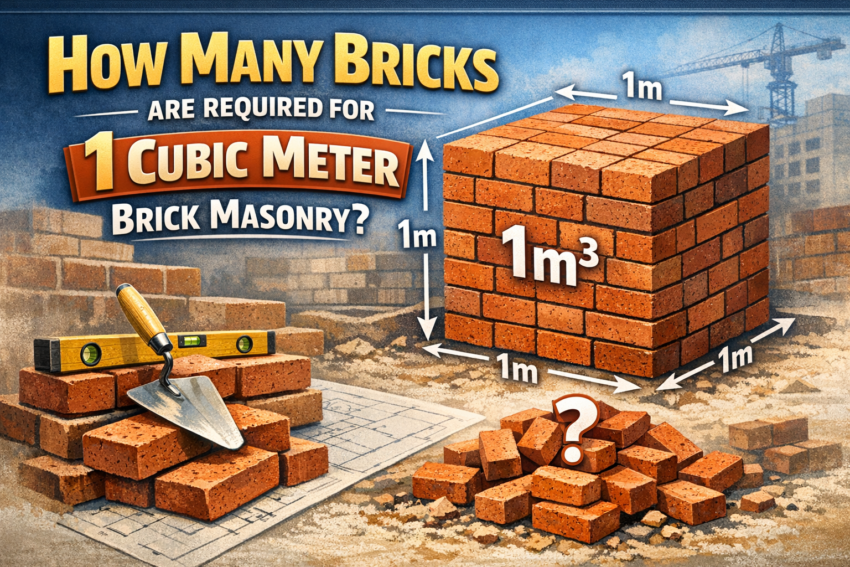
Short answer first: For standard brick masonry, 1 cubic meter requires about 500 bricks (including mortar allowance).
Now let’s turn this into a full and detailed explanation.
Estimating the number of bricks in 1 cubic meter of brick masonry is one of the most common calculations in civil engineering, quantity surveying, and construction planning. Whether you’re preparing a BOQ, estimating project cost, or planning material procurement, this calculation forms the foundation of accurate masonry work.
This guide breaks down the calculation step-by-step, explains the logic behind it, and provides ready-to-use values for different brick sizes.
Standard Brick Size
In India, the most commonly used brick size is:
- 190 mm × 90 mm × 90 mm (without mortar)
- With mortar (10 mm thick): 200 mm × 100 mm × 100 mm
Mortar thickness increases the overall volume of each brick unit, which affects the total number of bricks per cubic meter.
Volume of One Brick (With Mortar)
Brick size with mortar=200 mm×100 mm×100 mm
Convert to meters:
0.20×0.10×0.10=0.002 m3
So, one brick with mortar occupies 0.002 m³.
Number of Bricks in 1 Cubic Meter
Number of bricks=10.002=500 bricks
Thus, 500 bricks are required for 1 m³ of brick masonry.
Quick Reference Table
| Brick Size (mm) | Brick Volume with Mortar (m³) | Bricks per m³ |
|---|---|---|
| 190 × 90 × 90 (Standard) | 0.002 | 500 |
| Modular Brick (190 × 90 × 90) | 0.00198 | 505 |
| Traditional Brick (230 × 110 × 70) | 0.00198 | 505 |
Values may vary slightly depending on mortar thickness and workmanship.
Why Mortar Thickness Matters
Mortar joints (usually 10 mm) increase the effective size of each brick. If you calculate using brick size without mortar, you get:
0.19×0.09×0.09=0.001539 m3
10.001539≈650 bricks
This is incorrect for practical masonry because bricks are always laid with mortar. Hence, 500 bricks/m³ is the accepted and standard value.
Practical Considerations on Site
- Breakage/Wastage: Add 5–10% extra bricks.
- Mortar Ratio: Commonly used ratios are 1:4 or 1:6.
- Brick Quality: Overburnt or underburnt bricks may affect volume and count.
- Workmanship: Joint thickness may vary slightly.
Final Answer
✔ 1 cubic meter of brick masonry requires 500 bricks (standard practice).
✔ Add 5–10% extra for wastage → 525 to 550 bricks.
Read Also –
Download National Building Code 2016 – Volume 1 & Volume 2 [PDF]
CPWD Handbook on Seismic Retrofiting of Buildings