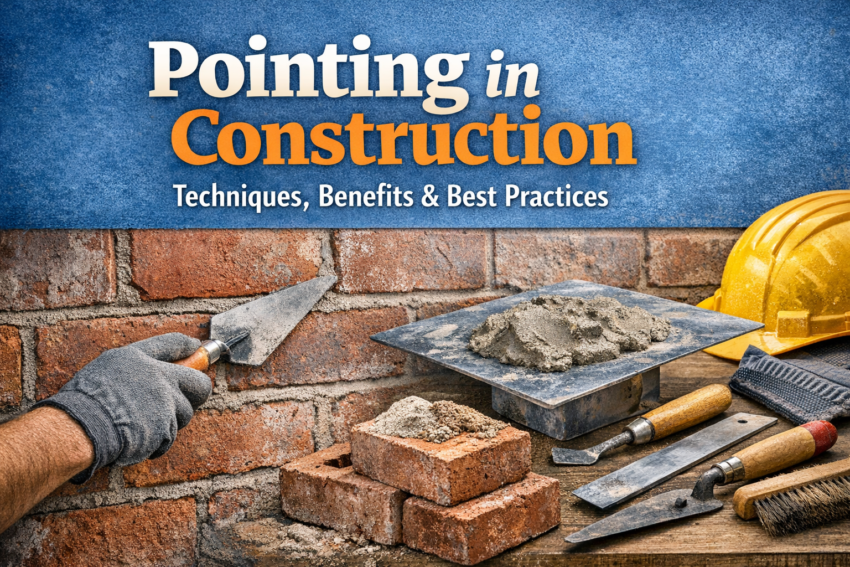
Pointing in construction is the process of finishing or renewing mortar joints in brick or stone masonry to protect against weathering and improve appearance; it’s done by raking out old mortar and packing new mortar into joints, with several joint profiles and mortar types to choose from.
What pointing is and why it matters?
Pointing fills and finishes the visible mortar joints between masonry units to prevent water ingress, reduce deterioration, and enhance aesthetics. It can be applied as new work or as repointing when joints have eroded. Typical mortar mixes are lime-based for historic work and cement-based for modern masonry; common mix ratios are around 1:2 to 1:3 (binder : sand) depending on binder and application.
Common types of pointing (what to choose and when)
- Flush pointing — mortar finished level with the masonry face; good for a clean, weather-resistant finish.
- Recessed pointing — mortar set back from the face; traditional look but can trap water; avoid in heavy-rain climates.
- Struck pointing — joint angled to shed water; practical for exposed walls.
- Beaded, V‑grooved, weathered, keyed — decorative or functional profiles used to match historic character or improve runoff.
Step‑by‑step procedure (practical workflow)
- Assess and test: inspect joints for depth and soundness; test a small area to determine mortar compatibility.
- Rake out deteriorated mortar to a depth of 10–20 mm (or until sound mortar remains).
- Clean and dampen joints to improve bond.
- Pack new mortar in layers, compacting to avoid voids; tool to the chosen profile once thumb‑firm.
- Cure appropriately (keep damp for lime mortars; protect cement mortars from rapid drying).
Key considerations and decision points
- Historic vs modern masonry: use lime mortars for softer, older masonry to allow movement and vapor permeability; use cement mortars for stronger, modern brickwork.
- Climate: recessed joints can retain water—avoid in wet climates.
- Color and tooling: match mortar color and joint profile to preserve appearance; sample patches first.
Risks, limitations, and best practices
- Incompatible mortar (too hard cement on soft stone) can cause spalling and accelerated decay — always test compatibility.
- Poor raking or packing leaves voids that trap moisture; ensure full compaction and correct depth.
- Safety: use eye protection, dust masks, and safe scaffolding when working at height.
Quick recommendations
- For conservation use lime-based mixes and match original tooling.
- For durability on new brickwork, a well-cured cement mortar with flush or struck joints is practical.
Read Also-
What Is Shotcrete? Complete Guide to Process, Equipment, and Uses
What is Stucco Plaster? Construction Basics
How many bricks are required for 1 cubic meter brick masonry?
Coping in Building Construction – Civil Engineering
Bricks & Brick Masonry – an Explainer
Download Also-