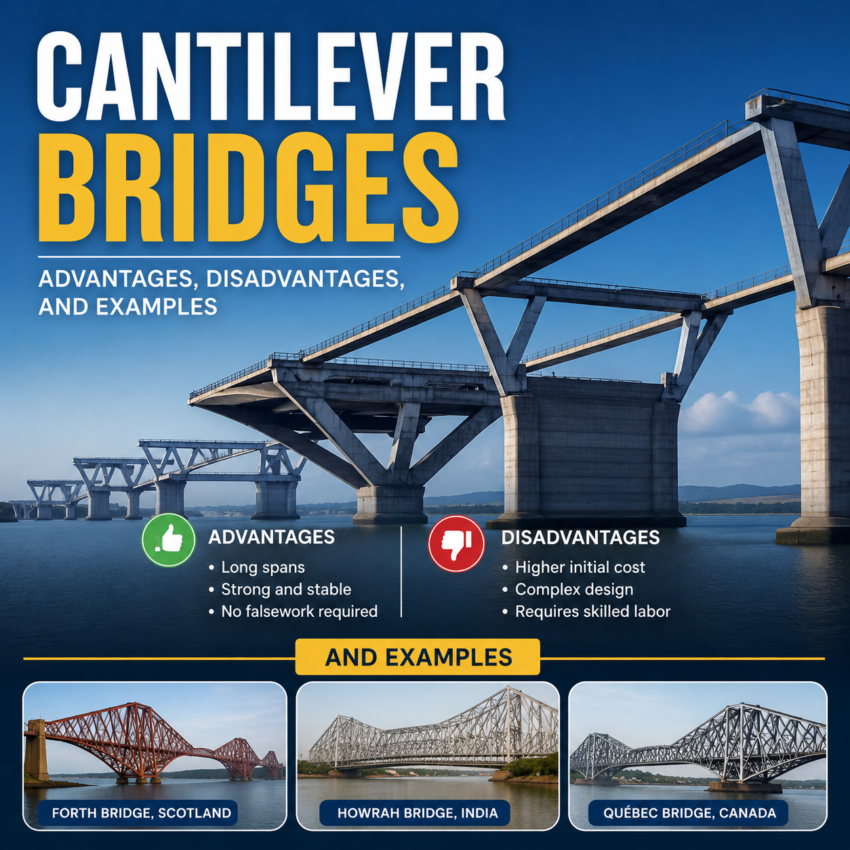
If you’ve ever driven across the Delaware River on the Commodore Barry Bridge or crossed the East River into Queens on the “59th Street Bridge,” you’ve experienced a cantilever bridge. One of the most practical and enduring solutions in bridge engineering. Long before cable-stayed and modern suspension bridges dominated skylines, cantilever bridges solved a problem that had stumped engineers for centuries: how do you build a long-span bridge over deep water or a busy shipping channel without building temporary supports in the water itself?
This post breaks down how cantilever bridges work, the main types you’ll encounter, their advantages and disadvantages, and several well-known examples across the United States and beyond.
How a Cantilever Bridge Works?
A cantilever is a rigid structural member that’s fixed or anchored at only one end and projects freely into space at the other — think of a diving board. A cantilever bridge uses two of these projecting arms, extending toward each other from opposite piers, until they meet (or nearly meet) in the middle of the span.
Each cantilever “arm” is balanced by an anchor arm on the landward side, which is either weighted down, anchored into an abutment, or extended to a back span. The anchor arm counteracts the overturning moment created by the cantilever arm’s overhang — much like a see-saw balances around its pivot point.
In many classic designs, the two opposing cantilever arms don’t touch directly; instead, they support a suspended span (sometimes called a drop-in span or Gerber girder) that rests on pins or hinges between them.
Because each arm is self-supporting as it’s built outward, contractors can construct the bridge from both piers simultaneously without needing falsework (temporary shoring) in the gap below — a major reason cantilever bridges became the go-to choice for crossing deep gorges and navigable rivers.
Types of Cantilever Bridges
-
Cantilever Truss Bridges The classic form, built from triangulated steel trusses that form the cantilever and anchor arms. This design carries loads efficiently over very long spans and was the dominant choice for major rail and highway crossings from the late 1800s through the mid-1900s. The Forth Bridge, Queensboro Bridge, and Commodore Barry Bridge are all cantilever truss bridges.
-
Cantilever Girder (Box Girder) Bridges
Rather than open trusses, these use solid steel or, more commonly today, post-tensioned concrete box girders. They’re typically erected using the **balanced cantilever construction method**: segments are cast or lifted symmetrically outward from each pier using a movable form traveler, then post-tensioned together as work progresses.This is now the standard technique for many modern highway flyovers, elevated urban expressways, and medium-span river crossings, even when the finished bridge doesn’t visually resemble a traditional truss cantilever.
-
Bridges With a Suspended Span
The traditional configuration: anchor arm → cantilever arm → suspended span → cantilever arm → anchor arm. The center suspended span sits on hinges between the two cantilever arms, which makes the overall structure statically determinate and easier to analyze. The Forth Bridge and Commodore Barry Bridge both use this layout. -
Bridges Without a Suspended Span
In some designs, the cantilever arms extend far enough to meet directly, or one arm meets the far abutment, without an inserted center span. The Queensboro Bridge is a notable example — its designer, Gustav Lindenthal, omitted the suspended span in favor of massive steel eyebars, aiming to reduce deflection and movement under live load.
Advantages of Cantilever Bridges
-
No falsework needed in the gap below. This is the single biggest advantage — construction doesn’t require temporary piers in deep water, a busy shipping channel, or a deep gorge, which can be difficult, dangerous, or simply impossible elsewhere.
-
Minimal disruption to traffic or navigation below during construction, since work proceeds outward from the piers rather than up from the base of the gap.
-
Economical for long spans (roughly 300 to 1,800 feet) without the tall towers and extensive cabling that suspension and cable-stayed bridges require.
-
Faster, parallel construction — crews can build outward from both piers simultaneously.
-
Statically determinate behavior (when hinges are used) simplifies structural analysis and makes the bridge less sensitive to differential settlement of the foundations, useful on sites with variable soil conditions.
-
Versatile loading — cantilever bridges have carried everything from heavy freight rail to highway traffic to pedestrians.
-
Repeatable, quality-controlled construction for the modern balanced cantilever concrete method, since each segment follows the same casting and stressing sequence.
Disadvantages of Cantilever Bridges
-
Heavier structurally than suspension or cable-stayed designs of similar span, since the structure resists bending as a rigid cantilever rather than relying on pure tension in cables.
-
Less economical at very long spans. Beyond roughly 1,800 feet, suspension and cable-stayed designs become more efficient and cost-effective.
-
Complex design and staged analysis. Engineers must check stresses at every construction stage, not just the finished structure, since the unfinished cantilever arm is more vulnerable than the completed bridge.
-
Temporary vulnerability during construction Before the arms are connected, additional bracing, counterweights, or temporary supports are often needed to keep the cantilever stable.
-
Maintenance-intensive hinges and joints. The pin connections at a suspended span are potential sites for long-term fatigue, corrosion, and wear, and they require regular inspection.
-
Heavy foundation loads from the anchor arms and piers, which can be a challenge on sites with poor soil conditions.
-
Historical cautionary lessons. The original Quebec Bridge, still the longest cantilever span in the world, famously collapsed twice during construction — in 1907 and again in 1916 — due to design and detailing errors before it was finally completed in 1917. It’s a case still studied in engineering curricula as a reminder of why redundancy and rigorous load-path verification matter at every construction stage, not just in the finished design.
| Bridge | Location | Main Span | Completed | Notes |
|---|---|---|---|---|
| Ed Koch Queensboro Bridge | Manhattan–Queens, NYC (East River) | 1,182 ft (360 m) | 1909 | Double-decked; longest cantilever span in North America until the Quebec Bridge opened in 1917 |
| Commodore Barry Bridge | Chester, PA – Bridgeport, NJ (Delaware River) | 1,644 ft (501 m) | 1974 | Longest cantilever span in the United States |
| Crescent City Connection | New Orleans, LA (Mississippi River) | 1,575 ft (480 m) | 1958 / 1988 (twin spans) | Carries a business route of I-90 across the river |
| Veterans Memorial Bridge | Gramercy, LA (Mississippi River) | 1,460 ft (445 m) | 1995 | — |
| Astoria-Megler Bridge | Astoria, OR – Point Ellice, WA (Columbia River) | Steel cantilever through-truss | 1966 | Longest continuous truss bridge in North America |
| Original Tappan Zee Bridge | Tarrytown–Nyack, NY (Hudson River) | 1,211 ft (369 m) | 1955–2017 | Replaced by the cable-stayed Governor Mario M. Cuomo Bridge in 2017 |
Final Thoughts
Cantilever bridges represent one of the most elegant solutions to a stubborn construction problem: how to build a long-span bridge without working from below. That advantage made them the bridge type of choice for over a century of major river and rail crossings, and it’s why the balanced cantilever method remains a workhorse construction technique today, even as the overall look of modern bridges has changed.
Read Also –
OSHA Field Safety and Health Manual
Types of Bridge Abutments: A Complete Guide
Top 5 Best Construction Scheduling Software
Top 10 Concrete Admixture Making Companies in USA (2026 Updated)