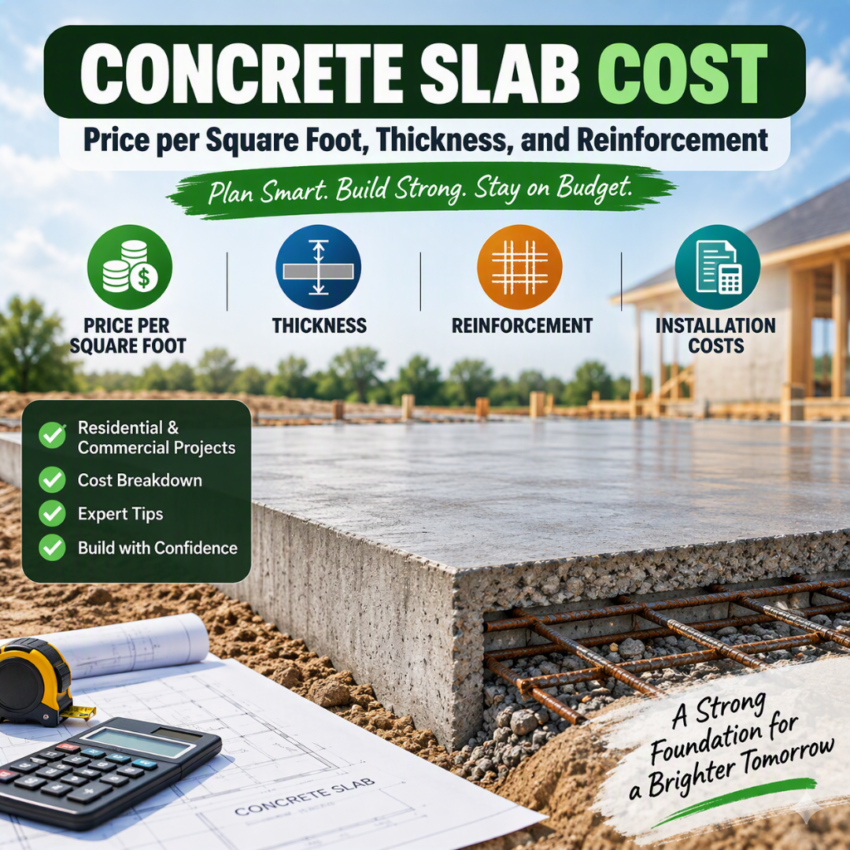
Are you planning to construct a concrete slab? If you’re pouring a small patio, a garage floor, or a full driveway, knowing what drives the final cost helps you plan and budget accurately.
This blog post will help you calculate concrete slab costs by thickness, slab size, materials, labor, and reinforcement type. It is noteworthy to know that concrete slab costs vary regionally, so you can build a realistic estimate before you hire a contractor.
Concrete Slab Cost by Thickness and Slab Size
Concrete slab pricing is driven by two numbers that multiply against each other: square footage and thickness. Thickness determines how many cubic yards of concrete you need, and cubic yards determine the bulk of your material cost.
Common Residential Thicknesses
| Thickness | Typical Use | Concrete (per 100 sq ft) | Material Cost (per sq ft) |
| 3.5 inches | Sidewalks, garden paths | ~1.1 cu yd | $3.50 – $5.00 |
| 4 inches | Patios, driveways, garage floors | ~1.25 cu yd | $4.00 – $6.00 |
| 5 inches | Light vehicle traffic, RV pads | ~1.55 cu yd | $5.00 – $7.50 |
| 6 inches | Heavy loads, commercial vehicles | ~1.85 cu yd | $6.00 – $9.00 |
Standard residential slabs are almost always 4 inches thick. It is code-minimum in most jurisdictions for patios and garage floors, and it is the thickness most flatwork quotes assume unless you specify otherwise.
Cost by Slab Size (Installed, Including Labor)
Total installed cost — materials, labor, sub-base, and basic finishing — typically runs $6 to $12 per square foot for a standard 4-inch residential slab.
| Slab Dimensions | Square Footage | Low Estimate | High Estimate |
| 10×10 | 100 sq ft | $600 | $1,200 |
| 12×12 | 144 sq ft | $865 | $1,730 |
| 16×16 | 256 sq ft | $1,535 | $3,070 |
| 20×20 | 400 sq ft | $2,400 | $4,800 |
| 24×24 | 576 sq ft | $3,455 | $6,910 |
| 30×30 | 900 sq ft | $5,400 | $10,800 |
City price factors matter here. A 400-square-foot slab that costs $2,800 in Tulsa, OK might run $4,500 in Seattle, WA, or $5,000+ in San Francisco. Major metro markets — New York, Boston, Los Angeles, Chicago — routinely add 30–60% to baseline national estimates due to higher labor rates, permitting costs, and delivery minimums.
Material vs. Labor vs. Sub-Base Breakdown
Understanding how cost is divided helps you spot where to negotiate and where cutting corners has consequences.
Typical Cost Split for a 4-Inch Patio Slab
For a standard 20×20 (400 sq ft) patio slab at a national average of roughly $8/sq ft ($3,200 total):
| Cost Component | Approx. Percentage | Dollar Range |
| Concrete material | 35–40% | $1,100 – $1,300 |
| Labor (pour + finish) | 30–35% | $960 – $1,120 |
| Sub-base (gravel/compaction) | 10–15% | $320 – $480 |
| Forming and setup | 8–12% | $255 – $385 |
| Miscellaneous (permits, curing) | 3–7% | $95 – $225 |
Concrete Material Costs
Ready-mix concrete is priced per cubic yard. National averages range from $125 to $175 per cubic yard delivered to your site. Minimum delivery orders are usually 1–3 cubic yards — small slabs under 1 cubic yard may incur a short-load surcharge of $50–$100.
Formula to calculate cubic yards: (Length × Width × Thickness in inches / 12) / 27
Example for a 20×20 slab at 4 inches: (20 × 20 × 0.333) / 27 = 4.94 cubic yards. Budget for 5.2 cu yd including 5% waste.
Labor Costs
Concrete flatwork labor runs $2.50 to $4.50 per square foot for basic pour-and-finish work. That range covers grading, forming, pouring, screeding, and a standard broom finish. Decorative finishes (stamped, exposed aggregate, polished) add another $3–$15/sq ft on top.
Sub-Base Costs
A properly compacted sub-base is non-negotiable for slab longevity. Plan on 4–6 inches of compacted gravel (typically 3/4-inch crushed stone or Class II base). Material and installation adds $0.75 to $1.50 per square foot.
Rebar, Mesh, and Fiber Reinforcement
Reinforcement prevents cracking and holds the slab together if cracks do form. The right choice depends on your load requirements, soil conditions, and budget.
Wire Mesh (Welded Wire Fabric)
Cost: $0.15 – $0.30 per square foot installed
Welded wire mesh (WWF) — typically 6×6-W1.4xW1.4 or 10×10 gauge — is the entry-level reinforcement option for residential slabs. It is economical and widely used for patios and sidewalks that will not bear vehicle loads.
Limitation: Wire mesh must be properly elevated (not resting on the sub-base) to be effective. When mesh sits on the ground, it ends up at the bottom of the slab and does almost nothing structurally. Many professionals have shifted away from mesh toward rebar or fiber for this reason.
Rebar
Cost: $0.75 – $1.50 per square foot installed
Rebar — typically #3 (3/8-inch) or #4 (1/2-inch) steel bars — is the standard reinforcement for garage floors, driveways, and any slab bearing vehicle traffic. Bars are laid in a grid pattern, typically 12–18 inches on center, and supported on chairs to maintain correct placement at mid-slab depth.
- #3 rebar on 18-inch centers: appropriate for pedestrian-load slabs
- #4 rebar on 12-inch centers: recommended for vehicle traffic and heavier loads
- #4 rebar on 12-inch centers (double mat): heavy commercial or structural applications
Rebar adds meaningfully to both material cost and labor — plan on 1–2 extra hours of labor per 100 square feet for rebar placement.
Fiber Reinforcement
Cost: $0.10 – $0.25 per square foot (added to concrete mix)
Polypropylene or steel fibers are added directly to the concrete mix at the batch plant, eliminating the need for mesh or reducing rebar requirements. Fiber reinforcement controls plastic shrinkage cracking (early-stage cracking as the slab cures) exceptionally well.
| Reinforcement Type | Best For | Relative Cost | Crack Control |
| Wire mesh | Light patios, sidewalks | Low | Moderate |
| Rebar #3 on 18″ | Patio, light driveway | Moderate | Good |
| Rebar #4 on 12″ | Garage, driveway | Moderate–High | Very Good |
| Fiber (polypropylene) | Crack control in any slab | Low–Moderate | Excellent (shrinkage) |
| Fiber (steel) | Industrial, heavy loads | Moderate | Excellent |
Many contractors now combine fiber in the mix with rebar — fiber handles plastic shrinkage, rebar handles structural loads.
Site Preparation, Delivery, and Finishing
The concrete itself is only part of the equation. Site conditions, accessibility, and finish choices have an outsized effect on final cost.
Site Preparation
Excavation and grading: $1.00 – $2.50 per square foot depending on soil conditions, depth of cut, and equipment access. Rocky soil, tree root removal, or significant grade changes push this higher.
Compaction: Sub-grade soil must be compacted before gravel is placed. Loose or fill soil requires extra passes or soil stabilization, adding $0.50–$1.00/sq ft.
Vapor barrier: A 6-mil polyethylene vapor barrier under interior slabs (garage floors, basement floors) adds $0.10–$0.25/sq ft — cheap insurance against moisture transmission.
Concrete Delivery Logistics
Standard delivery is included in the per-cubic-yard price within a typical 5–10 mile radius. Additional distance surcharges of $5–$15 per mile beyond the plant’s service zone are common.
Pump truck: When the truck cannot reach the pour location directly (backyards, elevated decks, tight access), a concrete pump is required. Pump rental and operation adds $200–$600 to the project, sometimes more for boom pumps on large jobs.
Short-load fees: Orders under 3 cubic yards at most batch plants trigger a short-load fee of $50–$100.
Standby fees: Concrete trucks charge standby fees — typically $1–$3 per minute — after a grace period (usually 5–8 minutes per cubic yard). An efficient crew matters.
Finishing Options and Costs
| Finish Type | Cost Adder (per sq ft) | Description |
| Broom finish | $0 (included) | Standard slip-resistant texture for driveways and patios |
| Smooth/trowel | $0.50 – $1.00 | Interior floors, requires more labor |
| Exposed aggregate | $2.00 – $4.00 | Decorative pebble surface, slip-resistant |
| Stamped concrete | $8.00 – $18.00 | Patterns mimicking stone, brick, wood |
| Stained/acid etched | $2.00 – $6.00 | Color treatment, applied after curing |
| Polished | $3.00 – $12.00 | Multi-step grinding process for interior floors |
Control joints (saw cuts or tooled joints) are cut every 10–15 feet to direct cracking. These are typically included in a base flatwork quote — saw cutting adds $0.10–$0.20/sq ft if billed separately.
Sample 12×12 and 20×20 Cost Breakdowns
Here are two fully itemized estimates at national average pricing for a standard 4-inch residential patio slab with rebar reinforcement and broom finish.
Project A: 12×12 Patio Slab (144 sq ft)
Concrete volume: 144 × (4/12) / 27 = 1.78 cu yd → order 1.9 cu yd with waste
| Line Item | Quantity | Unit Cost | Total |
| Ready-mix concrete (4,000 PSI) | 1.9 cu yd | $155/cu yd | $295 |
| Short-load fee | 1 flat | $75 | $75 |
| #3 Rebar (18-inch grid) | 144 sq ft | $0.90/sq ft | $130 |
| Gravel sub-base (4-inch depth) | 144 sq ft | $1.10/sq ft | $158 |
| Vapor barrier | 144 sq ft | $0.15/sq ft | $22 |
| Forming and setup | 48 linear ft | $4.50/lf | $216 |
| Labor – pour, screed, broom finish | 144 sq ft | $3.25/sq ft | $468 |
| Control joints (saw cut) | 4 cuts | $12/cut | $48 |
| Total | $1,412 | ||
| Per square foot | $9.80/sq ft |
City adjustment factors for this project:
| City / Region | Factor | Adjusted Total |
| Tulsa, OK / Memphis, TN | ×0.85 | ~$1,200 |
| Dallas, TX / Phoenix, AZ | ×0.95 | ~$1,340 |
| Denver, CO / Atlanta, GA | ×1.05 | ~$1,480 |
| Chicago, IL / Boston, MA | ×1.30 | ~$1,835 |
| Seattle, WA / Los Angeles, CA | ×1.40 | ~$1,975 |
| San Francisco, CA / New York, NY | ×1.60 | ~$2,260 |
Project B: 20×20 Patio Slab (400 sq ft)
Concrete volume: 400 × (4/12) / 27 = 4.94 cu yd → order 5.2 cu yd with waste
| Line Item | Quantity | Unit Cost | Total |
| Ready-mix concrete (4,000 PSI) | 5.2 cu yd | $150/cu yd | $780 |
| Delivery (standard radius) | — | included | $0 |
| #3 Rebar (18-inch grid) | 400 sq ft | $0.90/sq ft | $360 |
| Gravel sub-base (4-inch depth) | 400 sq ft | $1.10/sq ft | $440 |
| Vapor barrier | 400 sq ft | $0.15/sq ft | $60 |
| Forming and setup | 80 linear ft | $4.50/lf | $360 |
| Labor – pour, screed, broom finish | 400 sq ft | $3.00/sq ft | $1,200 |
| Control joints (saw cut) | 9 cuts | $12/cut | $108 |
| Total | $3,308 | ||
| Per square foot | $8.27/sq ft |
City adjustment factors for this project:
| City / Region | Factor | Adjusted Total |
| Tulsa, OK / Memphis, TN | ×0.85 | ~$2,810 |
| Dallas, TX / Phoenix, AZ | ×0.95 | ~$3,145 |
| Denver, CO / Atlanta, GA | ×1.05 | ~$3,475 |
| Chicago, IL / Boston, MA | ×1.30 | ~$4,300 |
| Seattle, WA / Los Angeles, CA | ×1.40 | ~$4,630 |
| San Francisco, CA / New York, NY | ×1.60 | ~$5,295 |
Why does the per-square-foot cost drop on the larger slab? Economy of scale. The crew setup, mobilization, and forming cost is spread across more square footage. Labor efficiency improves on larger pours, and you avoid the short-load surcharge. Larger slabs almost always cost less per square foot than smaller ones.
Quick Tips Before You Get Quotes
- Get at least three quotes. Concrete flatwork pricing varies significantly even within the same city. A 25–30% spread between quotes on the same spec is not unusual.
- Specify reinforcement in writing. Do not let “standard reinforcement” be ambiguous in a contract — write in whether you want #3 or #4 rebar, at what spacing, on chairs.
- Ask what PSI concrete is included. Most residential slabs use 3,000–4,000 PSI mix. Higher PSI adds cost but improves durability in freeze-thaw climates.
- Factor in permits. Many jurisdictions require a permit for slabs over a certain size (often 200 sq ft). Permit fees range from $50 to $400 depending on your city.
- Plan for drainage. A flat slab pools water. A slope of 1/8 inch per foot away from structures is a minimum — plan for it in the forming stage, not after the pour.
Read Also-
Top 10 Building Materials Companies in the USA
Top 5 Best Construction Scheduling Software
FE Civil Exam: Fees, Structure, Passing Criteria, and What Comes Next
New York Contractor License Complete Guide
California Plumbing Contractor License: Exams, Fees & Renewal