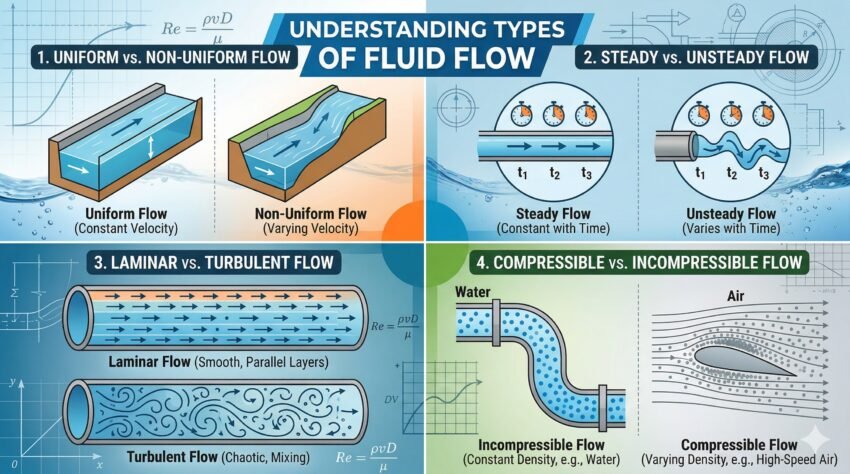
There are many types of fluid flow that exist in nature that are important for study. They are explained here.
Uniform Flow and Nonuniform Flow
- Uniform Flow
In this fluid flow, the velocity, depth, and pressure of the fluid remain constant at every section of the channel.Example: Water flowing at a constant depth through a long, straight canal with a consistent slope and cross-section.
- Nonuniform Flow
Nonuniform fluid flow has no requirement to possess the same properties at all places, like pressure, Velocity, and density in non-uniform.
Example: Water flowing through a tapering pipe or a river passing over a sudden drop (waterfall) or obstruction.
Steady Flow and Unsteady Flow
- Steady Flow
It is a type of flow in which fluid flow properties do not change with time. It should be noted that steady flow can be uniform or non-uniform.
Example: A tap turned on at a fixed position where the stream of water looks “frozen” in shape.
- Unsteady Flow It is a type of fluid flow with properties like pressure, velocity change with time. Example: The surge of water in a pipe when a valve is suddenly closed, or the waves in the ocean.
Rotational Flow and Irrotational Flow
- Rotational Flow
In rotational flow, the fluid particles rotate about their own axis as they move along a streamline.
Example: Flow around the solid boundaries is an example of rotational flow. Flow through turbine runner or flow around bends in pipes are examples of Rotational flow. Flow around curved surfaces is also a good example of rotational flow.
- Irrotational Flow
Irrotational fluid flow is one in which the fluid particles have zero angular velocity at every point
In this type of fluid flow, fluid particles do not rotate about their own axes as they flow along a streamline.Example: Flow far away from solid boundaries in a large reservoir
Laminar Flow And Turbulent Flow
- Laminar Flow
Laminar flow is a streamlined flow. This type of flow can be seen in viscous fluid flow. Also, a flow with higher velocity tends to exhibit laminar flow. This type of fluid flow has its particles follow a smooth or regular path.Example: A flow having Raynolds number up to 2300 is called a laminar flow. The best example of laminar flow is smoke from an incense stick; however, after some height flow becomes turbulent.
- Turbulent Flow
These types of flows are not streamlined flows. Flow at lower viscosity shows this type of flow characteristic. We can see eddies and swirls in a turbulent flow. A turbulent flow is characterized by a Reynolds number greater than 4000.Example: Water rushing in a fast mountain river or smoke rising from a cigarette.
Compressible Flow and Incompressible Flow
- Compressible Flow
In compressible flow, the fluid’s density changes significantly as it flows, often due to changes in pressure and temperature. Gases like air are typically considered compressible.Example: Air flowing at high speeds around an airplane wing.
- Incompressible Fluid Flow
In incompressible flow, the fluid’s density remains nearly constant as it flows. Liquids like water are typically considered incompressible for most practical engineering applications.Example: Water flowing through a municipal PVC pipe system.
Read Also-
Criteria For Selection of The Repair Material
Ready Mix Concrete-RMC And Its Advantages And Disadvantages
What Is RCC? Properties And Uses Of RCC
Self-Compacting Concrete – Properties and Application
Lightweight Concrete – Making and Applications Explained in Detail
FAQs
Reynolds no below 2000-2300 indicates laminar fluid flow.