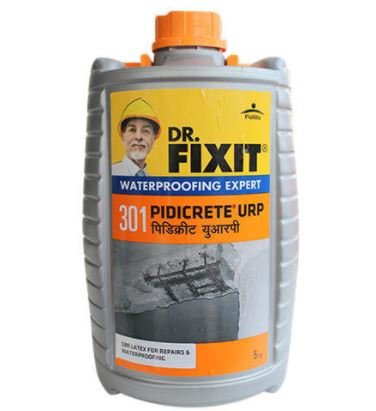
Concrete admixtures are chemicals or minerals that modify the properties of concrete. Concrete admixtures have a very wide range of applications and they come under various brand names. The most commonly used admixtures are listed and explained below.
Table of Contents
Plasticizers and Superplasticizers
Plasticizers are used to improve workability while keeping the water-cement ratio constant or in other words, plasticizers improve workability without increasing the water-cement ratio. They are also called water reducers.
The most commonly used plasticizer is Styrene Butadiene Rubber (SBR).
Superplasticizers are high-range water reducers. They are more advanced than plasticizers.
Here are some important types of superplasticizers.
- Polycarboxylate ester
- Modified lignosulphonates
- Cross-linked acrylic polymer
Set Retarders
These are used to reduce the rate of hydration of cement. Set retarders are most commonly used with Ready Mix Concrete. Common sugar is one of the most commonly used Set Retarder. Other admixtures used as Set Retarder are lignosulphonic acids and their salts.
Set Accelerators
Set Accelerators are used to increase the rate of hydration of cement. They have a very wide range of applications as explained below.
- It permits earlier removal of formwork.
- Reduce the required period of curing.
- Advance the time that a structure can be placed in service.
- Set accelerators are highly used in emergency repair work.
The most commonly used material, as set accelerators, till the 20th century, was Calcium Chloride, but now with advancements in technology, its use has become obsolete.
Some soluble carbonates are used as set accelerators.
Air-Entraining Admixtures
One of the most important evolutions in concrete technology is the invention of air entraining admixtures. There are two types of air voids in the concrete.
- Entrapped air (not a desirable one)
- Entrained air It is minute spherical bubbles introduced intentionally ranging in size from 5 microns to 80 microns
Air-Entraining Agents
The following types of Air-Entraining agents are used in today’s age
- Natural wood resins
- Animal and vegetable fats and oils
- Water soluble soaps of resin acids
- Aluminium Powder
The major alterations air-entraining admixtures make to the properties of concrete are –
- Reduction of strength
- Improved workability
- Very high resistance to frost action
Pozzolanic or Mineral Admixtures
These are mainly used to improve durability and decrease permeability. Silica fume, Fly ash, Rice husk ash, Surkhi, and blast furnace slag are commonly used pozzolanic admixtures.
They do not directly contribute to strength but affect permeability. Pozzolanic admixtures also reduce heat of hydration of concrete.
Other interesting facts about pozzolanic admixtures are-
- They reduce the alkali-aggregate reaction
- Lower costs of concrete for the same strength
- Pozzolanic admixtures improve the durability of the concrete.
- These admixtures make concrete resistant to sulfate attack.
- One of the major advantages of pozzolanic admixtures is lower cost and a sustainable product.
- Pozzolanic admixtures also give reduced bleeding and segregation.
Top 10 Concrete Admixture Companies in India
- Fosroc Chemicals India Pvt. Ltd.
- Sika India Pvt. Ltd.
- Pidilite Industries Ltd.
- Chembond Chemicals Ltd.
- BASF India Ltd.
- Maple Adhesive Industries India Pvt. Ltd.
- Fairmate Chemicals Pvt. Ltd.
- CICO Technologies Ltd.
- Guru Corporation
- Krystal Surface Solution
Read Also-
Top 10 Concrete Admixture Making Companies in USA
Shape Tests on Coarse Aggregates
Ready Mix Concrete Advantages, Disadvantages, And Other Aspects
Grades Of Concrete And Mix Ratio – A Detailed Description
Self-Compacting Concrete – Properties and Application
Factors Affecting Durability of Concrete Explained in Detail
FAQs
For construction in cold weather, Set Accelerators are best suited so that hydration of cement can be done before freezing of the mixing water of concrete. Other anti-freezing admixtures could also be used, such as sodium nitrite and sodium formate, to lower the freezing temperature.

Vimal Bhojani
I am a Civil Engineer and completed BE in Civil Engineering from GEC Rajkot in 2014. In 2018, I completed my ME in Structural Engineering from Marwadi College, Rajkot. I am a Life Member of the Indian Concrete Institute. I have 3 years of experience in site engineering and am still counting.