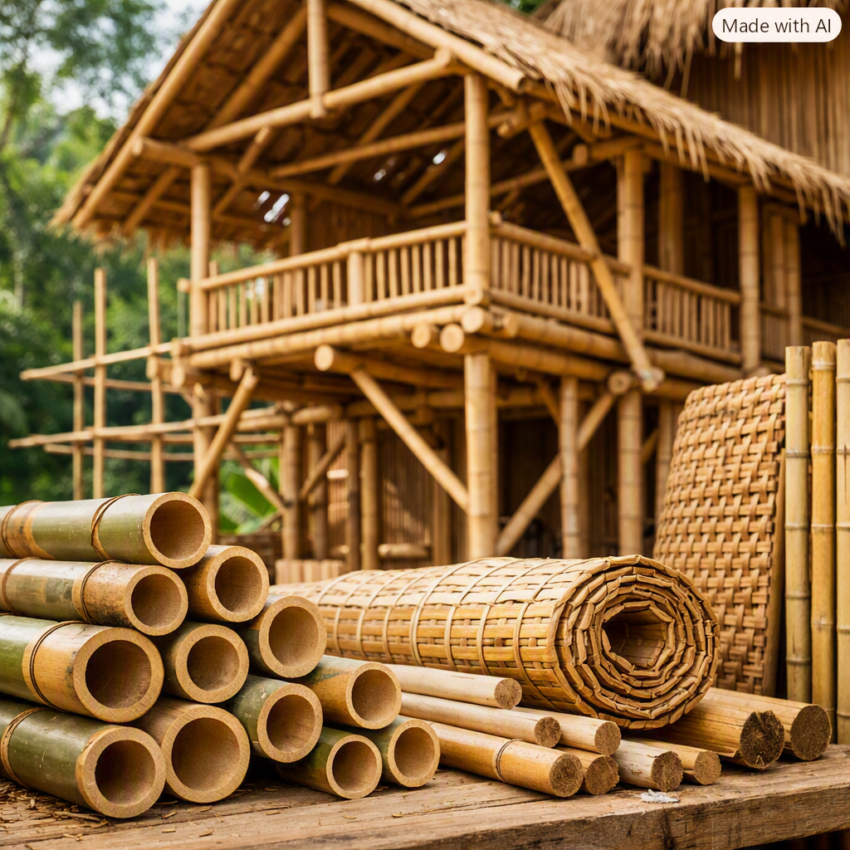
Bamboo is a fast-growing, high-strength grass that is increasingly used in construction as a sustainable alternative to timber. Bamboo also offers desirable tensile strength-to-weight ratio that rivals mild steel while sequestering significantly more carbon than conventional building materials.
For decades, bamboo construction was associated primarily with vernacular building in South and Southeast Asia. That perception is changing fast. In the United States, bamboo is now appearing in green-certified commercial interiors, accessory dwelling units (ADUs), flooring systems. Many projects are adopting International Code Council’s ICC 4000 Bamboo Standard.
This guide breaks down what bamboo actually is as an engineering material, where it performs well structurally, how US codes currently treat it, and what architects, engineers, and builders need to know before specifying it on a project.
What Makes Bamboo an Engineering Material, Not Just a Plant?
Bamboo isn’t wood. Botanically, it’s a grass (subfamily Bambusoideae), and that distinction matters structurally. Unlike timber, which grows via secondary thickening (adding rings over years), bamboo culms (stalks) reach full diameter in a single growing season and mature in 3 to 5 years — compared to 25 to 70 years for most structural timber species.
Structural Properties of Bamboo
- Tensile strength: Raw bamboo culms can reach tensile strengths of 200–400 MPa along the fiber direction, exceeding many mild steel grades on a strength-to-weight basis.
- Compressive strength: Roughly comparable to low-to-medium grade structural timber, typically 40–80 MPa depending on species, age, and moisture content.
- Hollow, tapered geometry: The culm’s natural tube shape gives high bending stiffness for its weight, but this same geometry complicates standardized connections — the biggest engineering challenge in bamboo design.
- Anisotropy: Like wood, bamboo is far stronger along the fiber (longitudinal) direction than across it, so design must account for this directional behavior.
Read Also- Foundation Repair in Buildings – Complete Guide (2026)
Raw Bamboo vs. Engineered Bamboo Products
For US construction, it’s important to separate two very different product categories.
Raw (Round Pole) Bamboo:
Whole, treated culms used in their natural tubular form — common in pavilions, pergolas, fencing, scaffolding (still standard in parts of Asia), and experimental structural framing. Raw bamboo requires chemical or thermal treatment (typically borax-boric acid or heat treatment) to prevent insect attack and decay, since untreated bamboo has very low durability outdoors.
Engineered Bamboo Products:
This is where most US commercial adoption is actually happening. Moso bamboo strips are laminated, strand-woven, or cross-laminated into dimensionally stable panels and boards:
| Product Type | Manufacturing Process | Typical US Use |
|---|---|---|
| Laminated bamboo lumber | Strips glued face-to-face under pressure | Furniture, cabinetry, some structural beams |
| Strand-woven bamboo (SWB) | Shredded fibers compressed with resin at high density | Flooring (hardest category, often exceeding oak on the Janka scale) |
| Bamboo plywood | Thin veneers cross-laminated | Sheathing, formwork, paneling |
| Cross-laminated bamboo (CLB) | Layers oriented at 90° like CLT | Emerging structural panels, pilot mass-timber-style projects |
Strand-woven bamboo flooring is by far the most established bamboo product in the US market, already competing directly with oak and maple hardwood flooring on hardness, cost, and appearance.
Is Bamboo Legal to Build With in the US?
This is the question most US-based architects and builders actually need answered, and it’s more nuanced than a simple yes or no.
ICC 4000-2022 (Standard for Bamboo Construction) is the key development. Published by the International Code Council and referenced by the 2024 International Building Code (IBC), it provides prescriptive design provisions for bamboo structural framing, connections, and material grading — effectively giving code officials a pathway to approve bamboo structural elements without a case-by-case alternative materials review.
Before ICC 4000, bamboo structural use in the US relied on IBC Section 104.11 (“Alternative materials, design and methods”), requiring engineers to submit independent testing data and calculations for local building department approval — a slower, more expensive, and jurisdiction-dependent process.
Practical takeaways for US practitioners:
- Engineered bamboo flooring and paneling products are already widely code-compliant as finish materials (subject to standard flame-spread and formaldehyde-emission testing like any other flooring product).
- Structural bamboo framing is legally achievable but still uncommon; expect to work closely with your local Authority Having Jurisdiction (AHJ), and budget time for engineering review even where ICC 4000 applies.
- California, Hawaii, and parts of the Pacific Northwest have been the most active US markets for structural bamboo pilot projects, partly due to climate suitability and stronger green-building code culture.
Where Bamboo Performs Well in US Construction?
- Flooring
Strand-woven bamboo flooring is the clearest commercial success story. It’s harder than most oak species, available pre-finished, and increasingly stocked by major US flooring retailers. Moisture sensitivity remains a limitation compared to some engineered hardwoods, so subfloor moisture testing matters.
- Interior Paneling and Millwork
Bamboo plywood and veneer panels show up in LEED-targeted commercial interiors, offices, and hospitality projects where rapid renewability contributes to sustainability credits.
- Scaffolding and Temporary Structures
While not common in mainstream US commercial construction (steel and aluminum scaffolding dominate due to OSHA familiarity and standardized load ratings), bamboo scaffolding remains relevant for specialty, cultural, or demonstration projects.
- ADUs and Low-Rise Structural Framing
A small but growing number of pilot projects — often architecture-school or sustainability-focused builds — use engineered bamboo or bamboo-hybrid framing for accessory dwelling units and pavilions, leveraging ICC 4000 as the compliance pathway.
- Reinforcement Research
Academic research (including US university programs) continues to study bamboo as a partial substitute for steel rebar in low-load concrete elements, primarily in developing-economy contexts rather than US commercial practice, due to bond-strength and durability limitations with concrete’s alkaline environment.
| Property | Bamboo (engineered) | Softwood Lumber | Structural Steel |
|---|---|---|---|
| Growth/production cycle | 3–5 years | 25–70 years | Not renewable (mined/recycled) |
| Tensile strength | High (fiber-direction) | Moderate | Very high |
| Weight-to-strength ratio | Excellent | Good | Moderate |
| US code pathway | ICC 4000 (2022) + IBC alternative materials | Fully prescriptive (NDS) | Fully prescriptive (AISC) |
| Connection standardization | Still developing | Mature | Mature |
| Carbon sequestration rate | Very high per acre | High | None (embodied carbon only) |
| US market maturity | Early (flooring mature, structural emerging) | Fully mature | Fully mature |
Sustainability View: Why the Interest Now
Bamboo’s appeal in US green building conversations comes down to a few measurable factors:
-
-
Rapid carbon sequestration: Certain bamboo species sequester more CO2 per acre annually than equivalent hardwood forest, due to fast biomass accumulation and continuous shoot regeneration without replanting.
-
No replanting required: Bamboo regenerates from the same rhizome system after harvesting, unlike timber, which requires full regrowth cycles.
-
–LEED and green certification relevance: Rapidly renewable materials (defined under LEED as those with harvest cycles of 10 years or less) can contribute toward Materials and Resources credits, and bamboo comfortably qualifies.
-
Lower embodied energy than steel or aluminum, though transportation impact matters — most raw and engineered bamboo used in the US is still imported from China, Vietnam, or Colombia, which is a legitimate lifecycle-analysis consideration for specifiers claiming sustainability benefits.
Limitations of Bamboo as a Building Material
-
Bamboo isn’t a drop-in replacement for timber or steel, and overstating its readiness does a disservice to project owners. Honest limitations include:
-
Durability without treatment: Untreated bamboo is highly susceptible to insect attack (particularly powderpost beetles) and fungal decay; every application exposed to weather or ground contact requires proper preservative treatment.
-
Connection design complexity: The hollow, tapered geometry makes standardized steel-style bolted or welded connections difficult; most systems rely on grouted joints, steel pins through filled culm sections, or proprietary connectors — none yet as standardized as timber connectors under the National Design Specification (NDS).
-
Limited US fabrication and supply chain: Domestic structural-grade bamboo processing capacity is minimal; most engineered product is imported, affecting lead times and cost predictability.
-
Fire performance data: Fire-resistance ratings for bamboo assemblies are less extensively codified in the US than for dimensional lumber or mass timber, requiring case-specific testing or engineering judgment in many jurisdictions.
- Insurance and lender familiarity: Structural bamboo projects can face friction with insurers, appraisers, and lenders unfamiliar with the material, which is a practical adoption barrier as much as a technical one.
FAQs
By weight, treated structural bamboo can have a higher tensile strength-to-weight ratio than mild steel. In absolute terms, however, steel’s yield and ultimate strength, along with its predictable, isotropic behavior, still make it the superior choice for most primary structural applications in the US.
Strand-woven bamboo flooring generally scores harder than red oak on the Janka hardness scale, making it comparably or more durable for foot traffic.
Not necessarily. As bamboo grows faster, it provides cheaper choice for flooring than timber.
Read Also-
Georgia Construction Contractor License Complete Guide
LEED Ratings Explained: A Complete Guide to LEED Certification Levels