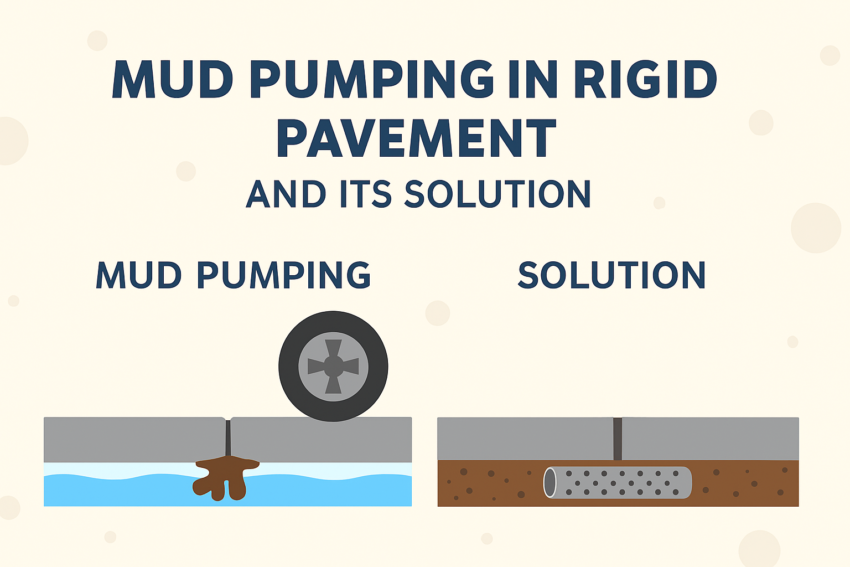
Mud pumping is the ejection of fine, water-saturated subgrade or base material through joints and cracks in cement concrete pavement when slabs deflect under traffic loads. It typically becomes noticeable after rain or when groundwater is present and can quickly reduce slab support. Mud pumping worsen joint distress, and shorten pavement life. Here in this blog, we have explored mud pumping and its solutions.
What Happens During Mud Pumping?
- Slab deflection under wheel loads pressurizes water trapped beneath the slab.
- Pressurized water forces fine particles upward through joints, cracks, or poorly sealed edges.
- Material loss under the slab creates voids, increases slab deflection, and accelerates cracking, corner breaks, and faulting.
Primary Causes of Mud Pumping
- Poor drainage and high water table — water accumulates beneath slabs and pressurizes when loaded.
- Fine-grained weak subgrade or base — clayey or silty soils with low permeability are easily entrained and pumped through openings.
- Inadequate joint sealing or damaged joints — open joints let water and fines migrate vertically into the pavement surface.
- Cyclic heavy loading — repeated axle loads cause repeated slab deflection and pumping action.
- Construction or material changes near joints — sudden moisture changes or weak transition layers beneath joints promote pumping.
Signs and Early Detection of Mud Pumping
- Wet slurry or dark stains emerging from joints after rainfall.
- Localized loss of support under slabs indicated by sagging or uneven ride.
- Progressive faulting and linear cracking near affected joints.
- Rapid reappearance of road surface fines after sweeping or heavy traffic following rain.
Short Term Repairs of Mud Pumping
- Full depth patching of severely damaged slabs to remove contaminated concrete and base material and restore slab integrity.
- Cleaning and resealing joints to stop water ingress where pumping is driven by open joints.
- Grouting or pressure grouting with cementitious or chemical grout to fill voids beneath slabs where access or reconstruction is impractical.
Long Term Solutions and Prevention of Mud Pumping
- Improve drainage
- Provide positive surface drainage to prevent ponding.
- Install or repair underdrains to lower the groundwater table and relieve water pressure under slabs.
- Stabilize or replace weak subgrade and base
- Remove and replace contaminated base with well-graded, non-fines material.
- Use lime, cement, or cement-lime stabilization to strengthen clayey/silty subgrades and reduce susceptibility to pumping.
- Joint and slab design improvements
- Use appropriate joint sealing materials and proper installation to prevent water entry.
- Improve load transfer across joints with dowel bars or tie bars where faulting or heavy loads are expected.
- Edge support and shoulders
- Ensure compacted, stable shoulders and edge support to reduce lateral movement of fines into joints.
- Material selection and specification
- Specify base and subbase materials with low fines content and adequate drainage capacity.
- Design pavement layers to limit slab deflection under expected traffic loads.
Remediation Strategy Workflow
- Investigate: Locate pumping sources, measure moisture and fines content beneath slab, and inspect joint seals.
- Remove and repair: Full depth repairs for damaged slabs; replace contaminated base where necessary.
- Stabilize subgrade: Use chemical or mechanical stabilization for weak or fine-grained soils.
- Restore drainage: Install/repair underdrains and surface drainage to prevent recurrence.
- Reinforce joints: Install dowels, reseal joints, and improve edge support to reduce water inflow and improve load transfer.
- Monitor: Periodically inspect after repairs to ensure pumping has stopped and underlying causes are controlled.
Practical Recommendations for Highway and Airport Pavements
- Prioritize drainage and subgrade investigation during design and maintenance planning.
- When pumping appears, act quickly with full depth repairs and drainage fixes rather than repeated surface patching.
- Use doweled joints on high-traffic pavements and ensure high-quality joint sealing to reduce water ingress.
- For pavements on expansive or silty clays, design for subgrade stabilization from the start to avoid costly remediation later.
Closing Note
Stopping mud pumping requires both structural repairs and controlling water beneath the pavement. Combining improved drainage, subgrade stabilization, sound material selection, and proper joint detailing prevents recurrence and restores long-term performance.
Read Also-
Under Reamed Pile Foundation – Geotechnical Engineering