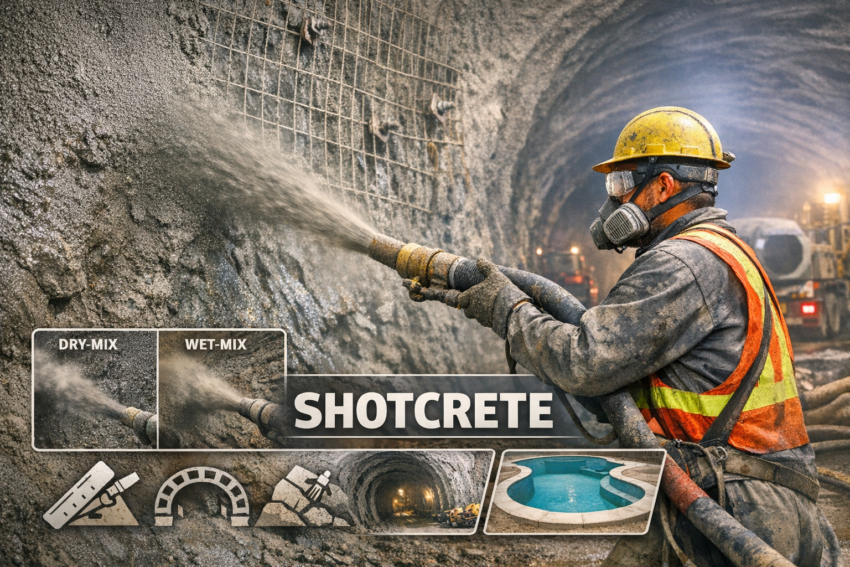
Shotcrete is pneumatically applied concrete or mortar sprayed at high velocity through a nozzle so it bonds and compacts on vertical, inclined, and overhead surfaces without conventional formwork. It is used for new construction, repair, stabilization, and architectural shaping where placing conventional concrete would be difficult or slow.
History and Evolution of Shotcrete
Origins: The shotcrete idea dates to the early 20th century when machines were developed to spray plaster and cementitious mixes through a nozzle; the dry-process “gunite” name became common in North America.
Modern Developments: Over the last century the technology evolved into two principal processes—dry-mix and wet-mix—supported by improved admixtures, fiber reinforcement, robotic spraying systems, and standards for quality control that make shotcrete a mainstream structural material.
Materials and Mix Design
Basic components: Shotcrete uses the same basic ingredients as conventional concrete: cement, fine and sometimes coarse aggregates, water, and admixtures. For thin layers and repairs a mortar (no coarse aggregate) is common; for structural linings coarse aggregate up to about 10 mm is typical.
Admixtures and Fibers: Common admixtures include accelerators for rapid set in overhead work, plasticizers to improve pumpability, and silica fume or fly ash to increase density and durability. Synthetic or steel fibers are often added to control cracking and improve post-crack behavior.
Design Considerations: Shotcrete mixes are designed for:
- Pumpability and sprayability so the mix conveys through hoses without segregation.
- Low rebound to reduce material waste at the nozzle.
- Early strength gain when overhead or temporary support is required.
- Durability for exposure conditions such as freeze–thaw, abrasion, or chemical attack.
Application methods and comparison
Shotcrete is applied by two principal methods: dry mix, and wet mix. The table below summarizes the most relevant attributes.
| Attribute | Dry-Mix (Gunite) | Wet-Mix |
|---|---|---|
| Water Addition | Water added at nozzle | Water mixed before pumping |
| Nozzle Skill Required | High | Moderate |
| Rebound | Lower when skilled; variable | Generally higher but consistent |
| Dust & Cleanup | Higher dust | Lower dust |
| Typical Uses | Repairs, overhead, intermittent work | Large linings, tunnels, continuous work |
How they work.
- Dry-mix process. A dry blend of cement and aggregates is fed into a hopper and conveyed by compressed air; water is injected at the nozzle so the material hydrates as it is sprayed. This method gives the nozzle operator fine control and is convenient for intermittent repair work.
- Wet-mix process. Fully mixed concrete is pumped to the nozzle and sprayed with compressed air. Wet-mix is preferred for large-volume work because it reduces rebound and dust and allows better control of mix uniformity.
Equipment, workforce, and safety
Core equipment:
- Delivery system: hopper, compressor, delivery hose, and nozzle assembly.
- Mixing plant: for wet-mix a concrete mixer or batching plant; for dry-mix a continuous feed hopper and air conveyance system.
- Support gear: compressors, water supply, and admixture dosing systems.
Skilled Roles:
- Nozzle operator (nozzleman): controls water addition, spray pattern, and compaction at the surface; skill level strongly affects rebound, finish, and bond.
- Pump and compressor operators: maintain steady delivery pressure and flow.
- Quality control technician: monitors mix properties, thickness, and curing.
Safety and Ergonomics:
- Personal protective equipment is essential because spraying generates dust and rebound fragments; respirators, eye protection, hearing protection, and protective clothing are standard.
- Ventilation is critical in confined spaces such as tunnels to remove dust and exhaust from compressors.
- Handling accelerators and other chemicals requires training to avoid skin and respiratory hazards.
Applications, Performance, and Case Examples
Common Applications of Shotcrete
- Tunnel linings and underground support where rapid placement and conforming to irregular rock are required.
- Slope stabilization and rockfall protection using sprayed concrete with mesh and anchors.
- Structural repair and rehabilitation of bridges, parking structures, and water-retaining structures because shotcrete bonds well to existing concrete.
- Architectural and free-form concrete for pools, sculptures, and façade repairs where formwork would be complex or costly.
Performance Highlights of Shotcrete
- High early strength and dense placement result from the high-velocity impact that compacts the material on the receiving surface.
- Good bond to irregular substrates makes shotcrete ideal for retrofit and repair work where surface preparation is limited.
Representative case note. Many modern tunnel projects use wet-mix shotcrete for primary support followed by fiber-reinforced secondary linings, combining speed with long-term durability.
Quality Control, Maintenance, Advantages, and Limitations of Shotcrete
Quality control measures
- Pre-placement testing: slump or flow, air content, and unit weight for wet mixes; for dry mixes check material gradation and moisture content.
- Thickness and coverage checks: use templates, cores, or non-destructive testing to verify layer thickness and bond.
- Curing: maintain moisture and temperature control to reduce shrinkage cracking and ensure strength development.
Maintenance and Repair
- Periodic inspection for cracking, delamination, or spalling is recommended; repairs are often performed with additional shotcrete layers or patching mortars.
Advantages
- No formwork required for many shapes and overhead work.
- Fast placement and the ability to work in confined or irregular spaces.
- Strong bond and dense placement with good durability when properly designed and cured.
Limitations
- Skilled labor dependency especially for dry-mix nozzlemen.
- Rebound and waste if not properly controlled.
- Dust and ventilation needs in enclosed spaces.
- Quality variability if mix design, equipment, or workmanship are inconsistent.
Conclusion
Shotcrete is a versatile, efficient, and technically mature method for placing cementitious material where conventional casting is impractical. When mix design, equipment, and skilled personnel are combined with robust quality control and safety practices, shotcrete delivers durable structural performance across tunnels, slopes, repairs, and architectural forms. For any project considering shotcrete, early collaboration between designers, contractors, and material suppliers will maximize the method’s benefits and minimize its risks.
Read Also-
Geopolymer Concrete: Properties and Benefits