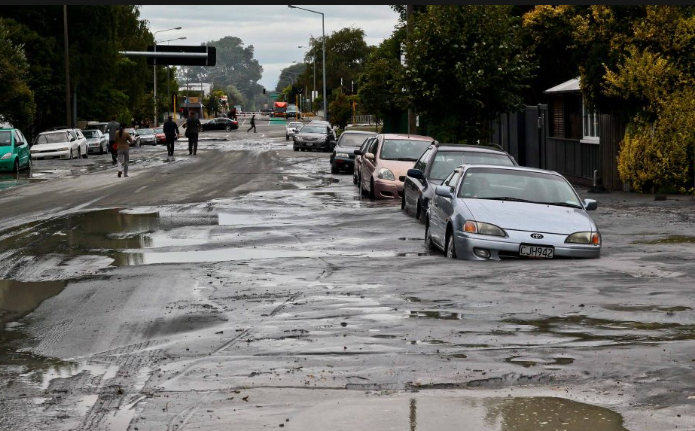
Soil liquefaction is a process in which, during an earthquake or application of dynamic load to the loose, saturated, and cohesionless soil, it loses all shear strength under the action of vibration caused due to earthquake or any other reason.
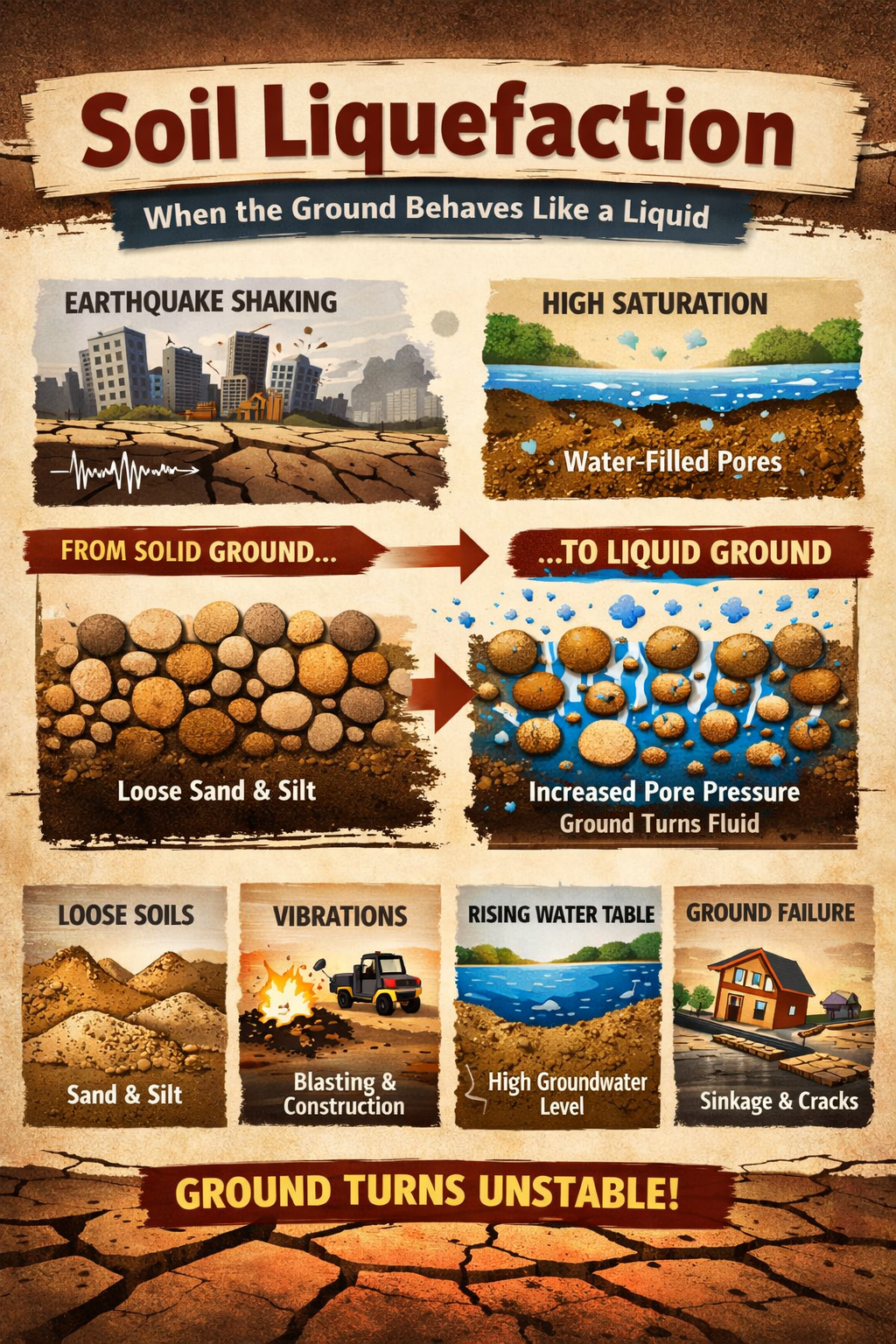
Causes of Soil Liquefaction
- Soil must be cohesionless: If soil is cohesive then there will be some shear strength possessed by soil, which prevents liquefaction.
- Soil must be loose, as compacted or dense soil does not exhibit liquefaction.
- Soil must be under dynamic stress. : If stress is static, pore water pressure may get enough time to dissipate.
- Soil must be in undrained condition.
Read Also – Geotechnical Engineering Interview Questions
Effects of Soil Liquefaction
- Structure may be sunk into the soil, or say an excessive settlement of the structure may be observed.
- In some cases, differential settlement may happen.
- During earthquakes, building foundations may experience differential settlement.
Mitigation of Soil Liquefaction
- Overburden pressure could be applied over the soil.
- If possible, soil should be replaced by other cohesive soil.
- Stone column should be placed.
- Proper drainage should be provided.
- Addition of cohesive material could help to mitigate the effect of soil liquefaction.
External References
Design Problems in Soil Liquefaction
Evaluation of Soil Liquefaction by Energy Principles
Read Also-
Types of Foundations used in construction
Mud Pumping in Rigid Pavement – Causes and Remedies
Types of Pile Foundations in Construction
Foundation on Black Cotton Soil – Problems and Solutions
Important books to study Geotechnical Engineering
FAQs
Soil liquefaction is mainly caused by strong ground shaking during earthquakes in water-saturated, loose sandy or silty soils, where pore-water pressure rises and soil particles lose contact, making the ground behave like a liquid.
Soil Liquefaction can be prevented by soil densification, drainage improvement, and groutind and chemical soil stabilization.