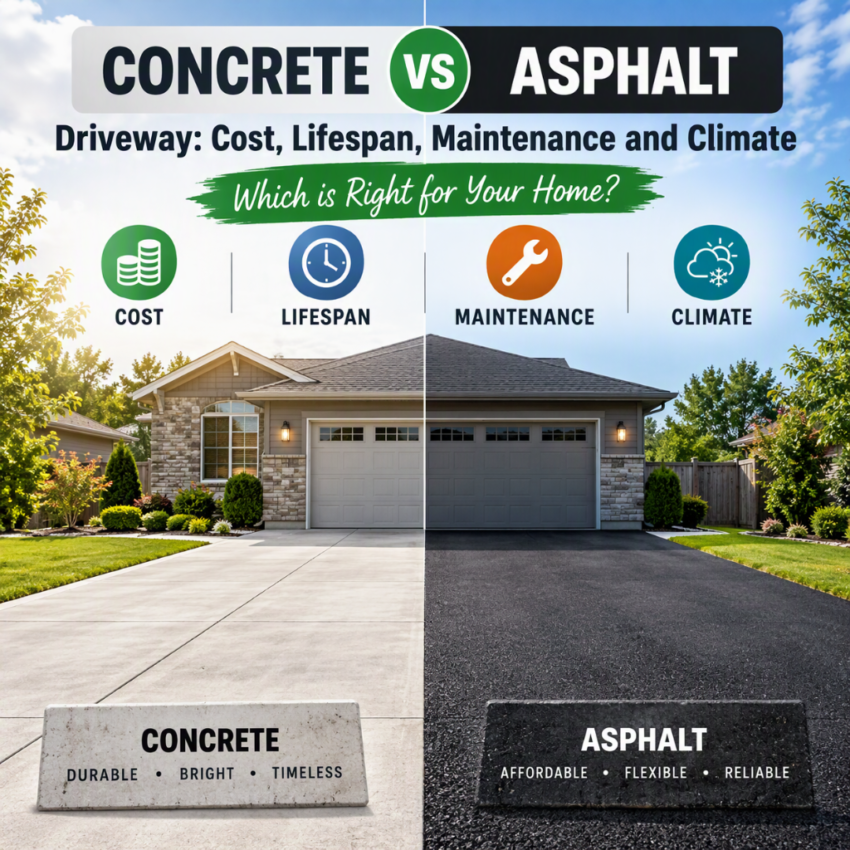
If you want a driveway laid and are concerned about budget and weather resistance, this blog post is for you. The choice between concrete and asphalt sounds simple until you start digging into the numbers – and realize that the “cheaper” option today can easily become the more expensive one over a 30-year horizon.
This blog post cuts through the noise with hard cost figures, real-world performance data, and climate-specific recommendations so you can make a decision you won’t regret the next time the mercury swings 60 degrees.
Side-by-Side Cost and Performance Table
The table below reflects national U.S. averages as of 2024-2025. Costs assume a standard two-car driveway of approximately 600 sq ft.
| Factor | Concrete | Asphalt |
|---|---|---|
| Installed cost (per sq ft) | $6 – $12 | $3 – $7 |
| Total installed cost (600 sq ft) | $3,600 – $7,200 | $1,800 – $4,200 |
| Lifespan (well-maintained) | 30 – 50 years | 15 – 30 years |
| Lifespan cost per year | $72 – $240 | $60 – $280 |
| Reseal frequency | Every 3 – 5 years (optional) | Every 2 – 5 years (required) |
| Crack repair cost | $300 – $500+ | $100 – $300 |
| Full replacement cost | $4,000 – $8,000 | $2,500 – $5,000 |
| Heat absorption | Low to moderate (reflects light) | High (retains heat) |
| Cold weather performance | Vulnerable to freeze-thaw and deicers | More flexible; handles freeze-thaw better |
| Stain visibility | High (oil shows clearly) | Low (dark surface hides stains) |
| Curb appeal / resale impact | Higher perceived value | Moderate |
| DIY-friendly? | No | Somewhat (sealcoating only) |
| Eco-friendly options | Pervious concrete, light-colored mixes | Recycled asphalt, permeable asphalt |
Bottom line: Concrete costs roughly 60–80% more upfront but lasts nearly twice as long. When you divide total lifecycle cost by years of service, the gap narrows considerably — and in warm, dry climates, concrete often wins on pure economics.
Installation and Curing / Opening Time
Asphalt Installation
Asphalt installation is fast and forgiving. A crew typically completes a standard residential driveway in one to two days. The process involves grading and compacting a gravel base (usually 4-8 inches), then laying 2-3 inches of hot-mix asphalt at around 300°F and compacting it with a roller while still hot.
Opening time: You can walk on fresh asphalt within 24-48 hours and drive on it within 48-72 hours in normal temperatures. However, asphalt doesn’t reach full hardness for 6-12 months – during that curing window, heavy vehicles, sharp turns, and high-heeled shoes can leave impressions, especially in summer heat.
Key installation caveats:
- Must be installed in temperatures above 50°F; cold weather installation causes poor compaction
- Rain on the day of installation is a dealbreaker
- Requires a first sealcoat within 6–12 months of installation
Concrete Installation
Concrete installation takes roughly the same time — one to two days for pouring – but the waiting game afterward is in a different league entirely.
The process involves setting forms, compacting a gravel base (4 inches minimum, 6 inches for heavier use), pouring the concrete mix, screeding, finishing, and cutting control joints to manage cracking.
Opening time: Foot traffic is possible after 24-48 hours. Light vehicle traffic typically requires waiting 7 days. Full cure – the point at which concrete reaches its design strength – takes 28 days. During this window, freshly poured concrete must be kept moist (curing blankets or curing compounds) and protected from freezing temperatures, which can ruin the slab.
Key installation caveats:
- Cannot be poured in freezing conditions without expensive cold-weather precautions
- Hot, dry, or windy weather accelerates surface drying and can cause cracking unless mitigated
- Control joints must be properly spaced (typically every 8-12 feet) to direct inevitable cracking
- Color, texture, stamping, or exposed aggregate finishes add $2–$8/sq ft but dramatically improve curb appeal
The practical takeaway: If you need your driveway usable in three days, asphalt wins. If you can wait a week and plan to stay in your home for decades, concrete’s longer cure pays off over time.
Freeze-Thaw, Heat, and Deicers
This is where material science meets real-world pain — and where more homeowners get burned than anywhere else in the concrete-vs-asphalt debate.
Freeze-Thaw Cycles
Water expands approximately 9% when it freezes. When water works its way into small pores or cracks in a driveway surface and then freezes, it exerts enormous internal pressure. Repeat this hundreds of times over a northern winter, and you get spalling, flaking, and cracking.
Asphalt handles freeze-thaw better than concrete. Its inherent flexibility allows it to shift slightly with ground movement, and water doesn’t bond to it the same way. That said, water can still penetrate cracks in older or poorly sealed asphalt and cause damage from below.
Concrete is more vulnerable to freeze-thaw damage. The key variable is the water-cement ratio — a low ratio (well-mixed, high-quality concrete) is far more resistant than budget mixes. Air-entrained concrete, which incorporates microscopic air bubbles to relieve internal pressure during freezing, is essentially mandatory in northern climates and significantly extends performance.
Heat Performance
Flip the calendar to July, and asphalt’s greatest liability emerges.
Asphalt softens in sustained high heat — typically above 120°F surface temperature, which is easily reached on a sunny 95°F day. Softened asphalt can rut under vehicle weight, leave tire marks, and even track into the house. Dark asphalt also absorbs radiant heat, making adjacent areas like garages noticeably warmer.
Concrete reflects more light and stays significantly cooler — surface temperatures can run 20–40°F lower than comparable asphalt on a hot day. It doesn’t soften, rut, or track. This thermal advantage matters especially in the Southwest, Southeast, and anywhere else summer temperatures regularly hit the 90s and beyond.
Deicers: The Hidden Threat to Concrete
This is a point that catches many homeowners off guard: common deicing salts are damaging to concrete, especially in its first few winters.
- Rock salt (sodium chloride) accelerates freeze-thaw damage by keeping water liquid at lower temperatures, increasing the number and depth of freeze-thaw cycles the surface endures.
- Calcium chloride is even more effective as a deicer — and even more corrosive to concrete.
- Magnesium chloride, widely used because it’s considered “concrete-safe,” still causes damage with repeated application.
The damage mechanism is two-fold: chemical attack on the cement paste, and accelerated freeze-thaw cycling. New concrete (less than one year old) is especially vulnerable and should be protected from all deicing salts for at least the first winter.
Asphalt is largely unaffected by deicers, which is a substantial practical advantage in the Snow Belt.
Safe alternatives for concrete driveways: sand for traction, coffee grounds, or specifically formulated “concrete-safe” products. Prevention — sealing, good drainage, and proper slope — is more effective than any deicer workaround.
Maintenance and Repair Differences
Asphalt Maintenance
Asphalt demands consistent attention, but the work is affordable and straightforward.
Sealcoating is the cornerstone of asphalt maintenance. A coal-tar or asphalt-emulsion sealer fills surface pores, blocks UV oxidation (which makes asphalt brittle and gray), and locks out water. Without it, an asphalt driveway oxidizes, cracks, and crumbles far ahead of schedule.
- First sealcoat: 6–12 months after installation
- Subsequent sealcoats: every 2–5 years, depending on traffic and climate
- Cost: $0.14–$0.25/sq ft DIY; $0.25–$0.75/sq ft professional
Crack filling should be done as soon as cracks appear — even hairline cracks — to prevent water infiltration.
- Crack filler or cold-patch products are widely available and genuinely DIY-friendly
- Cost: $5–$15 per crack for small cracks; $100–$300 for larger repairs
Pothole repair using cold-patch asphalt is a temporary fix; professional hot-patch repair is more durable but costs $100–$400 depending on size.
Full resurfacing (overlay) at year 15–20 adds another 10–15 years of life at roughly half the cost of full replacement — a major economic advantage of asphalt.
Concrete Maintenance
Concrete is genuinely lower-maintenance than asphalt — but when it does need repair, the results are rarely invisible.
Sealing concrete is optional but strongly recommended in freeze-thaw climates and areas with heavy deicer use. A penetrating silane/siloxane sealer blocks water and chloride intrusion without changing the surface appearance.
- Frequency: Every 3–5 years
- Cost: $0.15–$0.25/sq ft DIY
Crack repair is concrete’s Achilles’ heel. While concrete cracks can be filled with polyurethane or epoxy injection, repaired areas are almost always visible — the color never matches perfectly. For decorative or stamped concrete, repairs are especially conspicuous.
- Small crack fill: $100–$300
- Structural crack repair: $500–$2,500+
Resurfacing concrete with a bonded overlay can address widespread surface deterioration, but the substrate must be sound. Severely damaged concrete generally needs full removal and replacement.
Stain removal is an ongoing reality for concrete — oil, rust, and organic stains stand out against the light surface. Degreasers, acid washes, or pressure washing address most stains but require periodic effort.
Maintenance Cost Summary (over 30 years, 600 sq ft driveway)
| Maintenance Item | Asphalt (30 yrs) | Concrete (30 yrs) |
|---|---|---|
| Sealcoating | $1,200–$3,000 | $600–$1,500 |
| Crack/pothole repairs | $600–$1,500 | $500–$2,000 |
| Resurfacing (asphalt only) | $1,500–$3,000 | N/A |
| Total estimated maintenance | $3,300–$7,500 | $1,100–$3,500 |
Concrete’s lower maintenance burden is part of why its lifetime economics are more competitive than the upfront cost gap suggests.
Which Surface Suits Each U.S. Climate?
No single material wins everywhere. Climate is the deciding variable that should anchor your final choice.
Cold-Winter Climates – Northern States, Great Lakes, New England, Mountain West
Winner: Asphalt
Freeze-thaw cycles, heavy road salt use, and months of below-freezing temperatures stack the deck against concrete in the northern tier. Asphalt’s flexibility accommodates ground movement, it’s unaffected by deicers, and it absorbs enough heat to accelerate snow melt on sunny winter days – a genuine convenience benefit.
If you choose concrete in a cold climate, invest in air-entrained concrete, a quality sealer applied every 3–4 years, and commit to never using salt-based deicers. It can be done, but it requires discipline.
Recommended: Asphalt with biennial sealcoating, or high-quality air-entrained concrete with a penetrating sealer
Hot, Arid Climates – Southwest, Arizona, Nevada, Southern California
Winner: Concrete (clear)
Asphalt in Phoenix or Las Vegas is a liability. Surface temperatures routinely exceed 150°F in summer sun, causing rutting, tracking, and accelerated degradation. Concrete’s higher reflectivity keeps surface temperatures manageable, eliminates the softening problem entirely, and its freeze-thaw vulnerability is essentially irrelevant in a climate that rarely freezes.
Light-colored or white concrete also contributes to cooler microclimate temperatures around the home — a meaningful energy benefit in extreme heat zones.
Recommended: Standard or decorative concrete with a UV-resistant sealer; light-colored finishes preferred
Hot, Humid Climates – Southeast, Gulf Coast, Florida
Winner: Concrete (slight edge)
Florida and the Gulf Coast present minimal freeze-thaw risk, so the main battlefield is heat and moisture. Concrete handles heat well and doesn’t require the aggressive resealing schedule that humid climates demand of asphalt. However, moisture and organic growth (algae, mildew) can stain concrete over time.
Asphalt is a viable choice here — particularly because the cost savings are real and winters are non-issue — but it will require consistent maintenance in high-temperature, high-humidity conditions.
Recommended: Concrete for longevity; asphalt acceptable with diligent sealcoating
Moderate, Four-Season Climates – Mid-Atlantic, Pacific Northwest, Midwest Transitional Zones
Winner: Tie — personal preference and budget drive the call
In climates like the Carolinas, Tennessee, the Pacific Northwest, or the mid-Atlantic states, neither material faces an existential threat. Winters are cold enough to matter but typically don’t reach the extremes of Minnesota. Summers are warm but not southwestern.
Here, the decision comes down to:
- Budget: Asphalt’s lower upfront cost is a real advantage for homeowners who plan to sell within 15 years
- Curb appeal: Concrete, especially stamped or exposed aggregate, adds visible value and can support higher resale prices
- Maintenance tolerance: Asphalt needs more consistent attention; concrete needs more skilled (and expensive) repair when it does fail
Recommended: Either material with appropriate regional specifications; concrete for long-term owners, asphalt for budget-conscious or shorter-horizon homeowners
Quick-Reference Climate Chart
| U.S. Region | Best Choice | Key Reason |
|---|---|---|
| Northern states / Great Lakes / New England | Asphalt | Freeze-thaw resilience; deicer compatibility |
| Mountain West (high elevation) | Asphalt | Severe freeze-thaw; snowmelt chemicals |
| Southwest (AZ, NV, NM) | Concrete | Extreme heat; no freeze-thaw concern |
| Southern California | Concrete | Heat, low rainfall, low freeze-thaw risk |
| Southeast / Gulf Coast / Florida | Concrete (slight edge) | Heat performance; minimal freeze-thaw |
| Mid-Atlantic / Southeast transition | Either | Moderate conditions; budget decides |
| Pacific Northwest | Either | Mild temps; moisture management key |
| Midwest transitional (KS, MO, OK) | Asphalt (slight edge) | Ice storms; temperature swings |
The Bottom Line
There’s no universal winner – but there are clear winners for your situation.
If you live north of the Mason-Dixon line and salt your driveway every winter, asphalt is the pragmatic choice. If you’re in the Sun Belt planning to stay in your home for 30 years, concrete will pay for its premium many times over. And if you’re in the moderate middle, let your budget, your timeline, and how much you enjoy weekend maintenance projects tip the scale.
Whichever material you choose, the most important variables aren’t in the material itself — they’re in the quality of the base preparation, the skill of the installer, and the consistency of your maintenance. A well-built asphalt driveway outlasts a poorly built concrete one every time.
Read Also-
OSHA 1926.451 – Criteria for Scaffolding
General Contractor Licence Florida: Requirements, Costs, and Benefits
OSHA Field Safety and Health Manual