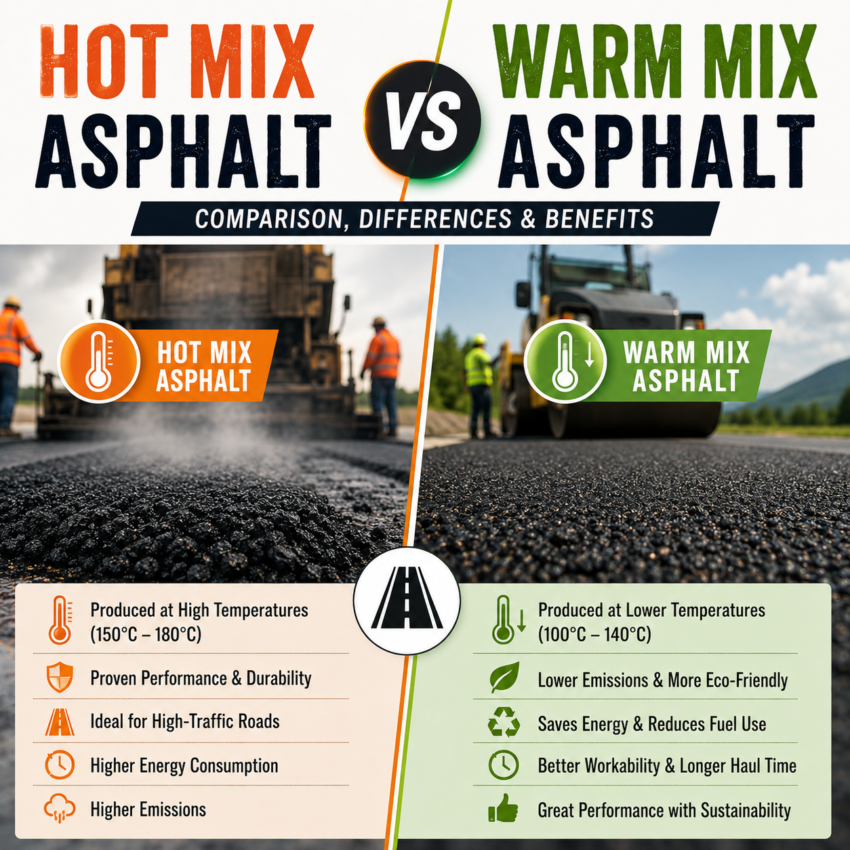
Asphalt pavements are the backbone of U.S. roads, parking lots, and airport runways. Choosing the right asphalt production and placement method affects cost, performance, worker safety, and environmental impact. This post compares Hot Mix Asphalt (HMA) and Warm Mix Asphalt (WMA) in depth for U.S. owners, engineers, contractors, and municipal decision‑makers, covering how each is made, performance differences, construction considerations, lifecycle costs, sustainability, and guidance for selecting the right approach.
Hot Mix Asphalt (HMA)
Definition and process. HMA is produced by heating asphalt binder and aggregates to high temperatures so the binder coats the aggregate and the mix is workable for transport and compaction. Typical plant and paving temperatures are in the range of 300–350°F (150–177°C). HMA has been the conventional choice for decades and is the baseline for most specifications and performance expectations.
Warm Mix Asphalt (WMA)
Definition and process. WMA uses technologies that allow mixing and compaction at lower temperatures—commonly 230–275°F (110–135°C)—by improving binder workability. Methods include:
- Chemical additives that reduce binder viscosity.
- Organic additives/waxes that temporarily lower viscosity.
- Water‑based foaming (introducing small amounts of water to create a foamed binder). These approaches let contractors produce and place asphalt at lower temperatures while achieving similar coating and compaction characteristics.
Why lower temperature matters. Lower production and placement temperatures reduce fuel consumption, emissions, and worker heat/fume exposure, and can extend paving seasons in cooler climates.
Technical performance: strength, durability, and compaction
Compaction and density
- HMA: High temperatures make compaction easier initially, but the mix cools faster during transport and placement, which can reduce the available compaction window—especially on long hauls or in cool weather.
- WMA: Lower temperatures but improved binder workability mean compaction can be achieved with fewer roller passes and over a longer time window. When properly compacted, WMA achieves in‑place densities comparable to HMA.
Rutting and stability
- Properly designed WMA mixes (aggregate gradation, binder grade, and additive selection) show similar rutting resistance to HMA in laboratory and field studies. Performance depends more on mix design and compaction than on production temperature alone.
Fatigue and cracking
- Studies show comparable fatigue life for WMA and HMA when the binder and mix design are equivalent. Some WMA technologies can slightly change binder stiffness at low temperatures; designers should verify low‑temperature cracking resistance with appropriate tests.
Moisture susceptibility
- WMA can be as resistant to moisture damage as HMA if anti‑stripping agents and proper aggregate selection are used. Quality control during production is critical.
Bottom line: With correct mix design, quality control, and compaction, WMA can match HMA performance for rutting, fatigue, and moisture resistance.
Environmental and worker health impacts
Emissions and air quality
- WMA reduces emissions of greenhouse gases (CO₂), fuel‑related pollutants, and volatile organic compounds (VOCs) compared with HMA because of lower burner fuel use and lower binder volatilization during mixing. This helps projects meet local air quality requirements and can reduce permitting burdens in some areas.
Energy consumption
- Lower plant temperatures translate to reduced fuel consumption per ton of asphalt produced. That reduces operating costs and carbon footprint.
Worker safety and comfort
- WMA lowers fume concentrations and radiant heat at the paving site, improving worker comfort and reducing heat‑related risks. This can be especially important for long shifts, summer paving, or projects with vulnerable crews.
Construction logistics and practical considerations
Paving season and weather
- WMA extends the paving season into cooler months and allows paving at lower ambient temperatures and on longer haul distances without losing compaction window. This is valuable in northern U.S. states and high‑elevation projects.
Haul distance and laydown
- Because WMA cools more slowly in terms of workability (not necessarily temperature), it tolerates longer hauls and delays between plant and paver better than HMA in many cases.
Equipment and training
- WMA typically requires no major equipment changes at the paving site; most plants can be retrofitted with WMA additive systems or foaming equipment. Contractors should train crews on WMA handling, compaction targets, and any additive dosing procedures.
Mix design and specification
- Agencies and contractors must document WMA mix designs and acceptance criteria. Many state DOTs have developed WMA specifications and approved additive lists. Quality control testing (e.g., density, binder content, volumetrics) remains essential.
Cost comparison and lifecycle economics
Short‑term costs
- HMA: Lower or no additive cost; higher fuel cost for heating.
- WMA: Additive or equipment cost (chemicals, foaming systems, or waxes) but lower fuel costs and often lower compaction labor/time.
Long‑term costs
- When WMA achieves equivalent density and performance, lifecycle costs are similar. Reduced energy use and emissions can translate to operational savings and potential incentives or credits for sustainability.
Example drivers that affect cost comparison
- Fuel price: Higher fuel prices favor WMA economics.
- Additive cost and dosing rate: Varies by technology and supplier.
- Project scale: Large projects amortize additive/equipment costs better.
- Regulatory incentives: Grants, credits, or permitting advantages for lower emissions can tilt the balance toward WMA.
Regulatory and specification landscape in the U.S.
- Many state DOTs and local agencies have adopted WMA specifications or guidance, and several have approved lists of WMA technologies. Agencies often require demonstration projects, performance verification, or specific acceptance testing before widespread use.
- Federal guidance and research (from agencies and universities) support WMA adoption by documenting performance and environmental benefits. Contractors should consult state DOT specifications and approved WMA product lists before bidding.
When to choose HMA vs WMA — practical guidance
Choose HMA when:
- Project specs or owner require traditional HMA (no WMA allowed).
- Additive availability or approved product lists are limited for the project jurisdiction.
- Contractor lacks experience with WMA and the project timeline or risk tolerance is low.
Choose WMA when:
- You want to reduce fuel use and emissions and improve worker safety.
- Paving in cooler ambient temperatures or with long haul distances.
- Project seeks sustainability credits, reduced permitting hurdles, or lower carbon footprint.
- Owner/agency encourages or requires WMA, or when lifecycle cost analysis favors WMA.
Best practices for successful WMA projects
- Start with proven technologies. Use WMA additives or foaming systems with documented performance and state DOT approvals.
- Pilot and demonstration projects. Run a small demonstration under local conditions to validate production, compaction, and performance before full adoption.
- Maintain rigorous mix design and QC. Verify volumetrics, binder content, and density targets; monitor moisture susceptibility and low‑temperature cracking potential.
- Train crews. Ensure plant operators, paving crews, and QC staff understand WMA handling, compaction targets, and any dosing procedures.
- Coordinate with the agency. Get approvals for WMA technology, mix design, and acceptance criteria early in the project.
- Document savings and performance. Track fuel use, emissions, compaction effort, and in‑place density to build a local case for WMA.
Case studies and evidence (summary)
- Multiple U.S. state DOTs and research institutions report that WMA can match HMA performance when properly designed and compacted, while delivering lower emissions and energy use. Agencies that have adopted WMA cite extended paving seasons, improved worker conditions, and comparable pavement life as primary benefits.
Common myths and clarifications
- Myth: WMA is weaker than HMA. Fact: Properly designed WMA has comparable strength and durability to HMA; performance depends on mix design and compaction, not temperature alone.
- Myth: WMA always costs more. Fact: Additives add cost, but fuel savings, reduced compaction time, and potential incentives often offset or exceed additive costs—especially on large projects or when fuel prices are high.
- Myth: WMA is experimental and unproven. Fact: WMA has been used widely across the U.S. for years, with many state DOTs approving specific technologies and mix designs.
Quick checklist for owners and spec writers
- Specify approved WMA technologies and acceptance criteria if you want to allow WMA.
- Require demonstration mixes or pilot sections for unfamiliar technologies.
- Include clear density and volumetric acceptance testing.
- Consider incentives for reduced emissions or energy use.
- Ensure contractors provide training and QC plans for WMA.
Conclusion Both Hot Mix Asphalt and Warm Mix Asphalt are viable choices for U.S. pavement projects. HMA remains the traditional standard with a long performance record. WMA offers measurable environmental and worker‑safety advantages, extended paving windows, and often comparable lifecycle costs and performance when mixes are properly designed and compacted.
Read Also-
How to Prepare for the PE Exam in Civil Engineering