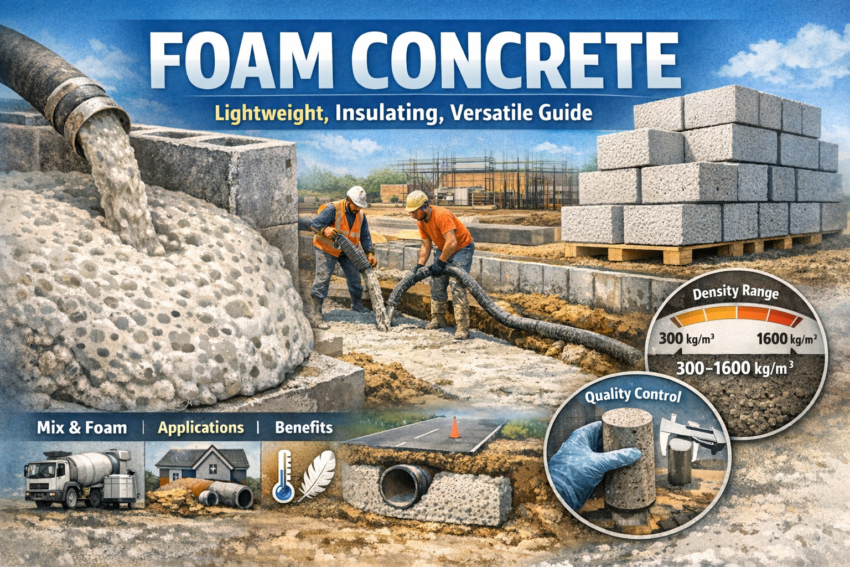
Foam concrete is a lightweight, cellular concrete made by mixing cementitious slurry with preformed foam; its density typically ranges from about 300 to 1,600 kg/m³, and it’s used for insulation, void-filling, lightweight blocks, and sub-base/roof fills.
Foam concrete (also called foamed concrete or cellular concrete) is produced by introducing a stable, engineered foam into a cementitious slurry (cement ± fly ash ± fine sand). It contains no coarse aggregate and forms a homogenous matrix of air bubbles in a cement paste, which gives it low weight and good thermal and acoustic properties.
Typical Composition and Production
- Binder: Ordinary Portland Cement or blended cements; fly ash and slag are common fillers to improve workability and reduce cost.
- Foaming agent: synthetic or protein-based surfactants produce stable bubbles; foam is usually generated in a separate machine and then mixed into the base slurry.
- Mix control: foam-to-slurry ratio sets density; water content and admixtures (plasticizers, stabilizers) control bubble stability and pumpability.
Key Properties and Performance of Foam Concrete
- Lightweight: densities from ~300 to 1,600 kg/m³; lower densities give thermal insulation but lower compressive strength.
- Thermal and acoustic insulation: closed-cell structure reduces heat transfer and sound transmission.
- Workability: highly flowable, can be pumped and poured into complex voids without compaction.
Quick planning guide — key considerations and decision points
- Purpose: insulation/thermal mass, structural infill, or non-structural void filling.
- Target density: 300–1,600 kg/m³ (lower density → lower strength and better insulation).
- Production method: pre-formed foam mixed into slurry (most common) vs. in‑mix foaming.
- Quality controls: foam stability, slurry consistency, curing regime, and density checks.
Common Applications of Foam Concrete
- Void filling and trench reinstatement, roof insulation and screeds, lightweight blocks and panels, sub-base for roads and pavements, and backfill for pipelines and tunnels.
Advantages and Limitations
- Advantages: low self-weight, good insulation, ease of placement, reduced dead load on structures, and potential use of industrial byproducts (fly ash).
- Limitations: reduced compressive strength at low densities, higher cement content (cost), potential for higher shrinkage, and longer setting times if not properly cured. Quality of foam and mixing critically affect performance.
Risks, mitigation, and quality control
- Risk: bubble collapse or segregation → inconsistent density and strength. Mitigation: use calibrated foam generators, measure wet density frequently, control slurry viscosity with admixtures, and follow recommended curing (moist curing or controlled humidity).
- Risk: shrinkage/cracking in thin sections → use fibers or shrinkage-reducing admixtures and staged pours.
Practical Recommendations
- Specify target density and minimum compressive strength in the contract.
- Use pre-formed foam systems and test trial mixes on-site to confirm pumpability and final density before full placement.
Foam concrete is a versatile, sustainable option where weight reduction, insulation, and ease of placement are priorities; success depends on rigorous mix control, foam quality, and curing.
Read Also-
Lightweight Concrete – Making And Applications
What Is Shotcrete? Complete Guide to Process, Equipment, and Uses
Geopolymer Concrete: Properties and Benefits
Glass Fiber Reinforced Concrete – Concrete Technology
Ground Granulated Blast Furnace Slag (GGBS)
FAQs
The cost of foam concrete lies between $150 to $240, depending on the properties you require. Bulk order gives lower price for foam concrete.